
Korg monologue
Lesson 1: Synth basics and a tour of the panel
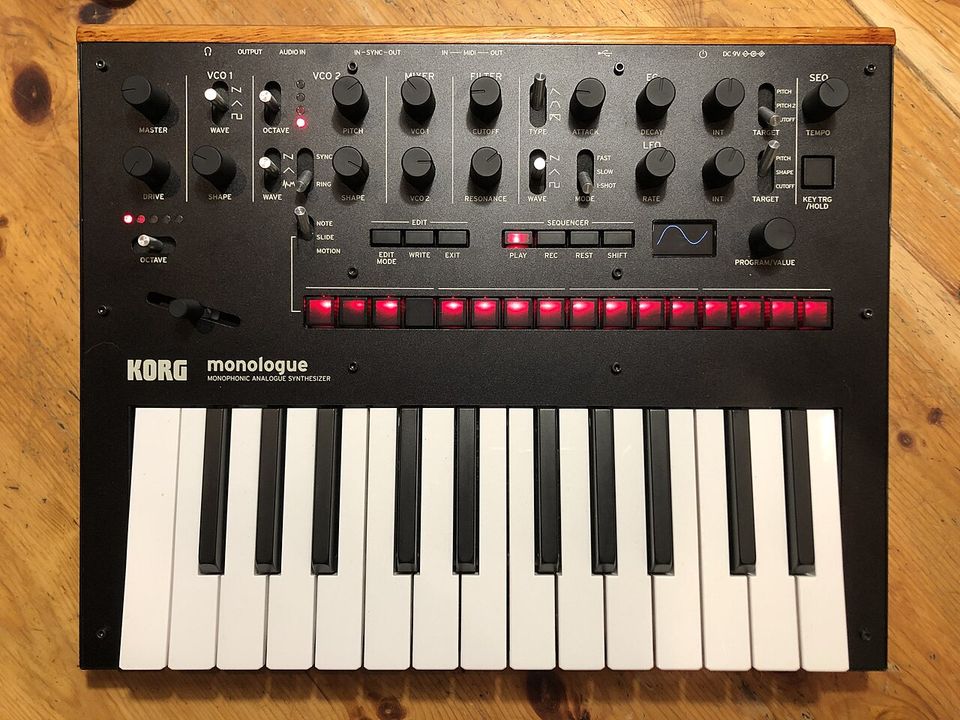
A subtractive synth starts with a bright, buzzy tone and carves it into shape. The monologue’s front panel is laid out left to right in roughly the order the sound travels, so once you know the path, you know where to reach.

Five ideas to understand first
- Oscillator (VCO). Makes the raw tone and sets its pitch. The monologue has two, VCO 1 and VCO 2.
- Filter (VCF). A low-pass filter removes the brightness above a cutoff point. Turning CUTOFF down makes the sound darker and duller.
- Amplifier (VCA) and envelope (EG). The envelope shapes how a note changes over time: how fast it starts (attack) and how it dies away (decay). On the monologue the single EG always shapes volume in some way and can also move pitch or cutoff.
- LFO. A low-frequency oscillator that wobbles another parameter repeatedly. On pitch it gives vibrato, on cutoff it gives a wah effect.
- Monophonic. One note at a time. Holding two keys still gives one note, which is what makes slides, legato lines and acid basslines work.
The signal path
- VCO 1 and VCO 2 generate the tones (VCO 2 can also produce noise).
- The MIXER sets how loud each oscillator is.
- The FILTER removes high frequencies, with RESONANCE adding a peak at the cutoff point.
- The VCA sets the final volume, shaped by the EG.
- DRIVE adds harmonics and distortion, and MASTER sets the output level.
The EG and the LFO don’t make sound themselves. They are modulators that move other knobs for you.
Panel tour, left to right
| Section | Controls | What it does |
|---|---|---|
| Master | MASTER, DRIVE | Output volume; adds grit and distortion |
| Performance | OCTAVE switch (5 positions), Slider | Shifts the keyboard ±2 octaves; the slider is a per-program controller, often pitch bend |
| VCO 1 | WAVE (saw, triangle, square), SHAPE | Tone of oscillator 1. Its pitch follows the keyboard and has no tuning knob of its own |
| VCO 2 | OCTAVE (16’, 8’, 4’, 2’), PITCH, WAVE (saw, triangle, noise), SYNC/RING, SHAPE | Tone and tuning of oscillator 2, plus sync or ring modulation against VCO 1 |
| Mixer | VCO 1, VCO 2 | Level of each oscillator |
| Filter | CUTOFF, RESONANCE | Brightness and emphasis |
| EG | TYPE, ATTACK, DECAY, INT, TARGET | Envelope shape, how strongly it acts, and what it moves |
| LFO | WAVE, MODE, RATE, INT, TARGET | Wobble shape, speed range, speed, amount, and what it moves |
| Sequencer | TEMPO, KEY TRG/HOLD, MOTION/SLIDE/NOTE, PLAY, REC, REST, SHIFT, buttons 1 to 16 | The 16-step sequencer |
| Edit | EDIT MODE, WRITE, EXIT, PROGRAM/VALUE knob, display | Menus, saving, choosing programs; the display doubles as an oscilloscope |
Rear panel: power switch, DC 9V, USB B, MIDI IN and OUT, SYNC IN and OUT (3.5 mm), AUDIO IN (6.3 mm mono), OUTPUT (6.3 mm mono) and headphones (6.3 mm stereo).
Exercise 1
Without looking at the table, point to the control that would make the sound darker, the one that would add vibrato, and the one that changes VCO 2’s tuning. Then say the signal path out loud from oscillator to output.