
Speaking with Confidence
Lesson 2: Working with nerves
Goal: understand what nerves are doing, and have three things to try the next time your heart races before you speak.
You are in good company
Fear of public speaking is the most common social fear. In a large US survey, about one adult in five said they had a strong fear of speaking in front of others at some point in their life, more than any other social situation (Ruscio and colleagues, 2008). Experienced speakers, actors and presenters still feel it. The difference is that they expect it and carry on.
Nerves show up in three ways (Bodie, 2010):
- Body: racing heart, shaky hands or voice, dry mouth, sweating, needing the toilet
- Thoughts: “I’ll go blank”, “they’ll think I’m an idiot”, replaying mistakes afterwards
- Behaviour: avoiding speaking, rushing to get it over with, reading every word, not looking up
They can’t see it as much as you feel it
Two well-tested effects help here.
- The spotlight effect: we overestimate how much other people notice about us. In one study, students wearing an embarrassing T-shirt thought about half the room had noticed. In fact only about a quarter had (Gilovich and colleagues, 2000).
- The illusion of transparency: we think our nerves are obvious. They mostly aren’t. In a speech study, simply telling people that audiences rarely notice nerves made their speeches better, and observers rated them as more composed (Savitsky and Gilovich, 2003). Good evidence for the effect itself; the speech result comes from one experiment.
So: your shaking hands feel huge to you. To the room, you look a bit serious.
Call it excitement
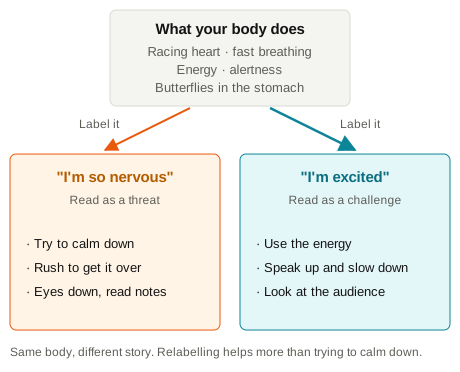
Nervousness and excitement feel almost the same in the body: fast heart, energy, alertness. Trying to “calm down” fights your body. Relabelling the feeling works with it.
In experiments, people who said “I am excited” out loud before a speech or a test did better and were rated as more persuasive and confident than people who said “I am calm” (Brooks, 2014). A related study found that telling people that arousal can help performance improved their maths test scores (Jamieson and colleagues, 2010). Some evidence: the effect is real but modest, and works best alongside preparation, not instead of it.
Try it: when your heart starts to race, say to yourself, “This is my body getting ready. I’m excited to do this.”
Slow your out-breath
A long, slow breath out is the quickest way to take the edge off. Breathe in through your nose for about four counts, out through your mouth for about six to eight. Two or three rounds before you stand up or unmute is enough. You can do it sitting in a meeting and no one will notice. Practitioner tip, consistent with research on slow breathing and arousal.
Prepare the first 30 seconds
Nerves peak just before and just after you start. Know your first two sentences cold, so your mouth can run while your brain catches up. For a meeting, that might be: “I’ve got one update and one question. The update is…” (Lesson 6 has more shapes like this.)
Practice is the real treatment
A 2019 meta-analysis of treatments for fear of public speaking found that cognitive behavioural approaches (gradual exposure to speaking, plus challenging the anxious thoughts) worked well, and the gains lasted (Ebrahimi and colleagues, 2019). Good evidence. In plain terms: speak more, in small steps, and check your predictions against what actually happens. That’s what a speaking club does every week or fortnight (Lesson 16).
Watching a recording of yourself also helps, especially if you first picture how you think you’ll look. Most people find they look far more composed than they felt (Harvey and colleagues, 2000).
When it’s more than nerves
If fear of speaking or social situations stops you doing things you need or want to do (avoiding meetings, turning down jobs, dreading phone calls for days), it may be social anxiety, which is very treatable. Talk to your GP, see healthdirect on social anxiety, or try a free online program such as MindSpot or the THIS WAY UP Social Anxiety Program.
Exercise 2
Before your next meeting or call where you plan to speak: do two slow breaths, say “I’m excited” to yourself, and have your first sentence ready. Afterwards, write one line in your speaking log: what you feared would happen, and what actually happened.
Listen
Conversations from the Legendary Lectures podcast, hosted by Al Barnett on the Gold Coast. These are personal stories and practitioner views, not research.
- Legendary Lectures #45, Courage Without Certainty with Becky Farrar: treating fear as a path to growth, from a speaker on identity and self-trust.
Sources
- Ruscio et al. (2008), Social fears and social phobia in the USA: results from the National Comorbidity Survey Replication, Psychological Medicine
- Bodie (2010), A racing heart, rattling knees, and ruminative thoughts: defining, explaining, and treating public speaking anxiety, Communication Education
- Gilovich, Medvec and Savitsky (2000), The spotlight effect in social judgment, Journal of Personality and Social Psychology
- Savitsky and Gilovich (2003), The illusion of transparency and the alleviation of speech anxiety, Journal of Experimental Social Psychology
- Brooks (2014), Get excited: reappraising pre-performance anxiety as excitement, Journal of Experimental Psychology: General
- Jamieson et al. (2010), Turning the knots in your stomach into bows: reappraising arousal improves performance on the GRE, Journal of Experimental Social Psychology
- Ebrahimi et al. (2019), Psychological interventions for the fear of public speaking: a meta-analysis, Frontiers in Psychology
- Harvey et al. (2000), Social anxiety and self-impression: cognitive preparation enhances the beneficial effects of video feedback, Behaviour Research and Therapy