
Speaking with Confidence
Lesson 6: Giving it a shape
Goal: build any update or talk around one clear message, with an opening and a close that do real work.
Start with one sentence
Before you plan anything else, finish this sentence: “If they remember one thing, it’s that …”
That’s your message. If you can’t write it in one sentence, you aren’t ready to speak yet; you’re still working out what you think. Everything else in the talk either supports that sentence or gets cut.
Some examples:
- Team update: “The new roster is working, but Fridays are still short by one person.”
- Committee proposal: “We should spend the grant on the kitchen, not the car park.”
- Wedding toast: “Sam is the friend who always turns up.”
Lead with the point
Writers in the military and in business call this BLUF: bottom line up front. In meetings and at work, people want the conclusion first and the detail second. Say your message in the first 30 seconds, then support it. If you run out of time, the important part has already landed. Practitioner tip.
Stories and speeches for entertainment can build to the point instead. Updates, proposals and answers shouldn’t.
A simple frame for most talks
| Part | Time (5-minute talk) | Job |
|---|---|---|
| Opening | 30 seconds | Get attention and say why it matters to them |
| Message | 15 seconds | Your one sentence |
| Body | 3 to 4 minutes | Two or three supporting points, each with an example |
| Close | 30 seconds | Restate the message; say what you want them to do |
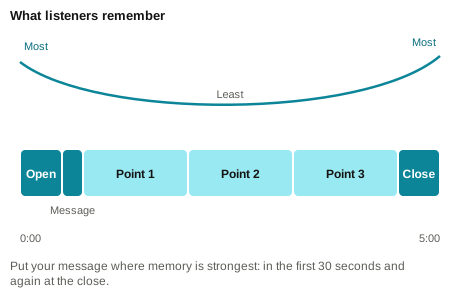
Three points is a good number: easy to follow and easy to remember. Two is fine. Seven is a list, not a talk.
Openings that work
- A question they actually want answered: “How many hours did we spend in meetings last week?”
- A short story or moment (Lesson 7): “Last Tuesday at 4 pm, the phones stopped working.”
- A surprising fact or number, with its source.
- Straight to the point: “I’m going to ask you to approve one change today.”
Avoid opening with apologies (“I’m not very good at this…”), housekeeping or a long thank-you list. The first and last things you say are remembered best (Murdock, 1962, on the serial position effect, Good evidence for memory of lists), so don’t waste them.
Signpost as you go
Listeners can’t flip back a page. Tell them where they are:
- “I’ve got three points. The first is cost.”
- “That’s cost. The second is timing.”
- “To sum up…”
It feels repetitive to you. To a listener, it’s a map.
Close with purpose
End on your message and a clear next step, then stop. Not “…so, yeah, any questions?” but:
“So the kitchen is where the grant does the most good. I’m asking for your vote tonight.”
If you take questions, take them before your final close, then finish with your message (Lesson 14).
Exercise 6
Pick something you need to say soon: an update, a proposal, a toast. Write the one sentence. Then write an opening line, two or three supporting points, and a closing line. That’s the whole plan on one index card. Use it.
Sources
- Murdock (1962), The serial position effect of free recall, Journal of Experimental Psychology
- Anderson, TED’s secret to great public speaking, TED (video: build your talk around one idea)