
Speaking with Confidence
Lesson 16: Clubs, mentors, coaches and contests
Goal: pick your next step, whether that’s a club visit, a mentor, a coach, or a contest, and put it in your calendar.
How a club meeting works, and why
Toastmasters is the largest network of speaking clubs, with clubs in most Australian suburbs and towns, online clubs, and clubs inside some workplaces. Rostrum is an Australian alternative. Formats vary from club to club, but a typical Toastmasters meeting runs for about 90 minutes to two hours, every week or fortnight, and every part of it has a purpose:
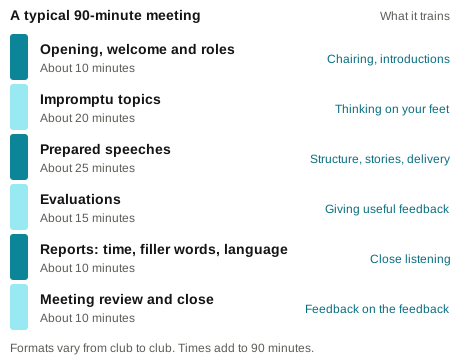
| Part or role | What happens | Why it’s there |
|---|---|---|
| Toastmaster (the host) | Runs the meeting, introduces each speaker, keeps it moving | Practice at chairing and facilitating (Lesson 9) |
| Table Topics | Members speak for one to two minutes on a surprise question | Impromptu speaking, the skill you use most (Lesson 5) |
| Prepared speeches | Two or three members give 5 to 7 minute speeches, each working on a project goal | Structure, stories and delivery (Lessons 6, 7 and 13) |
| Evaluators | Each speech gets a two to three minute spoken evaluation | Specific feedback for the speaker, and practice at giving it (Lesson 11) |
| Timer | Times every speaker and shows green, amber and red | Respecting time; learning what five minutes feels like |
| Ah-Counter | Notes filler words and repeated habits | Awareness of your verbal habits (Lesson 3) |
| Grammarian | Picks a word of the day and notes good and clumsy language | Listening closely to words |
| General Evaluator | Evaluates the whole meeting, including the evaluators | Feedback on the feedback, so evaluation keeps improving |
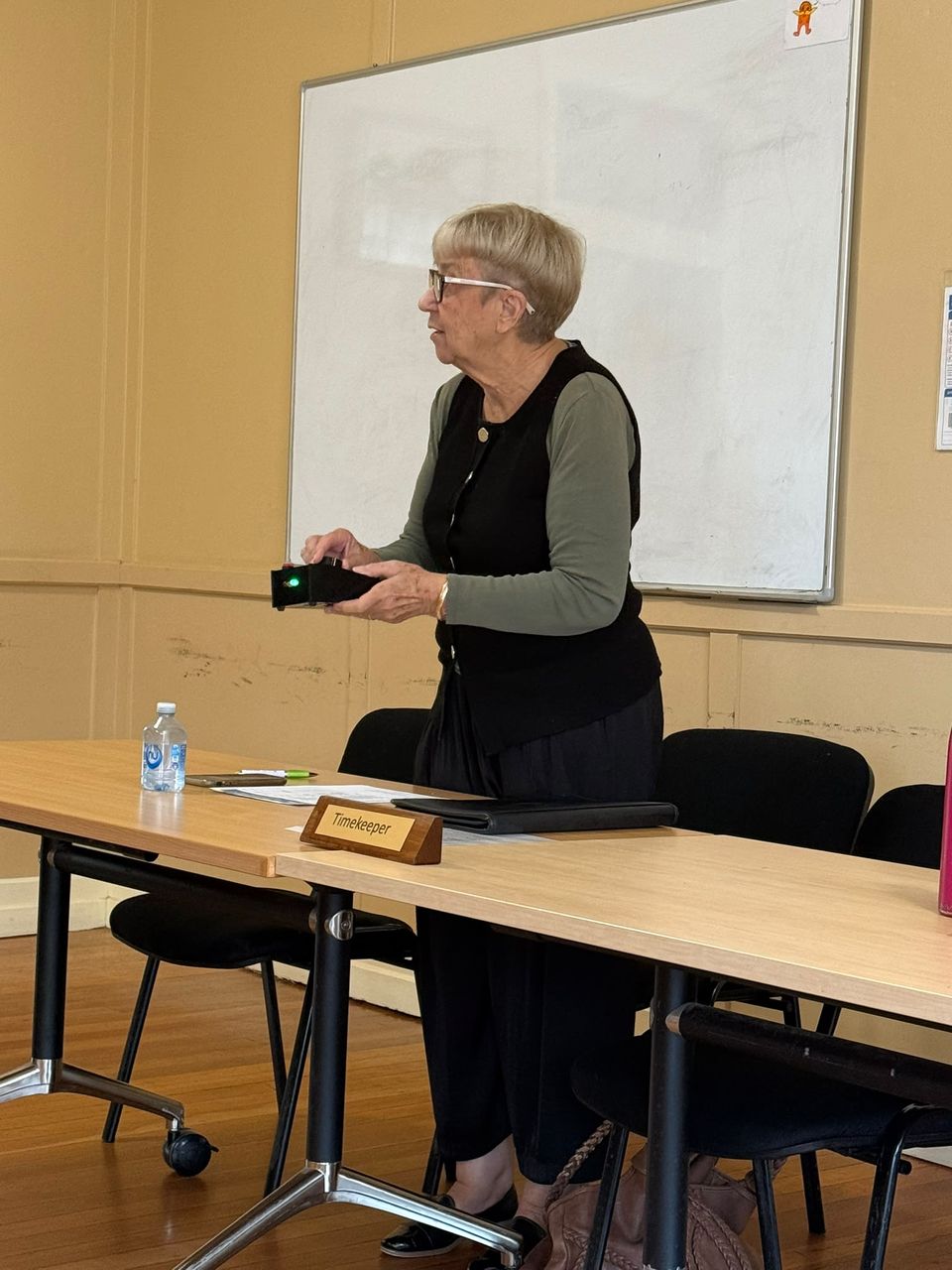
Notice that only a few people give a speech each meeting, but everyone else has a role. Every role is speaking, listening or leading in a small, safe dose. That’s why clubs say leaders are made there (Lesson 10): within a few months you will have chaired a meeting, run Table Topics and evaluated someone’s speech, and most of us never get that practice at work.
Clubs also elect officers (president, education officer, treasurer and so on) each year, which is a low-risk way to try leading a volunteer team.
Choosing a club
Visit two or three as a guest before joining. Clubs vary a lot in size, style, formality and time of day, and the right one is the one you’ll keep going back to. Guests are welcome and don’t have to speak, but saying yes to a Table Topic on your first visit is the fastest way to find out you can. There’s a membership fee, and the education program (Pathways) lets you choose a path suited to your goals.
This course is independent and not affiliated with or endorsed by Toastmasters International. Club details here are general descriptions to help you choose; check with any club you visit.
Get a mentor
A mentor is someone a few steps ahead of you who takes an interest in your progress: watches you speak, tells you what they see, shares what worked for them, and nudges you to take the next step. In Toastmasters, new members are usually paired with an experienced member for exactly this. It makes a real difference in the first few months.
The research on mentoring is positive, with honest caveats. Meta-analyses of workplace studies find that mentored people report more career satisfaction and commitment, and do a little better on pay and promotion, than similar people without mentors (Allen and colleagues, 2004; Eby and colleagues, 2008). Some evidence: the effects are real but modest, and people who seek mentors may differ from those who don’t.
A good mentor relationship for speaking:
- Agree one goal: “I want to stop reading my notes” or “I want to run the committee meeting without it running over.”
- Ask them to watch you speak, live or on video, and evaluate against that goal (Lesson 11).
- Meet briefly and often: a coffee or a 15-minute call each month beats one long session a year.
- Ask about their mistakes, not just their successes.
Your mentor doesn’t need to be in a club. A manager, a colleague who presents well, or a friend who runs meetings can all do this, if you ask.
Then become one
Mentoring someone else is one of the best ways to improve your own speaking. To explain what you do instinctively, you have to work out what it actually is. In learning studies, students who taught material to others remembered and understood it better than those who only studied it (Fiorella and Mayer, 2013), and a meta-analysis of mentoring found that mentors themselves report more job satisfaction and commitment (Ghosh and Reio, 2013). Some evidence.
You don’t need to be an expert to mentor. If you’ve given five speeches, you can help someone give their first. Offer to watch a colleague’s presentation rehearsal, or volunteer when your club asks for mentors. Mentoring is also leadership practice (Lesson 10): listening, giving feedback and helping someone else find their voice.
Join a choir
A speaking club trains what you say and how you deliver it; a choir trains the instrument itself. Weekly singing builds breath, projection, range and the habit of standing up in front of people, alongside the social side of belonging to a group. Lesson 3 explains why it helps your speaking voice, and how to find a non-auditioned community choir such as Vocal Waves on the Gold Coast.
Try theatre or improv
If a speaking club is the gym, theatre is the playing field. Community theatre teaches projection, movement, memorising, character voices and accents, and performing with nerves, all with a director giving you feedback. Improvisation (“improv”) classes go further on thinking on your feet: you make up scenes on the spot, and the core rule (“yes, and”: accept what your partner offers and build on it) is the same skill as good listening in a meeting (Lesson 11).
There’s some research behind it too. In one study, people with improv experience were more comfortable with uncertainty and reported better wellbeing (Felsman and colleagues, 2020), and a small pilot found that an improv course reduced symptoms of social anxiety and depression (Krueger and colleagues, 2017). Early evidence: small studies, but promising.
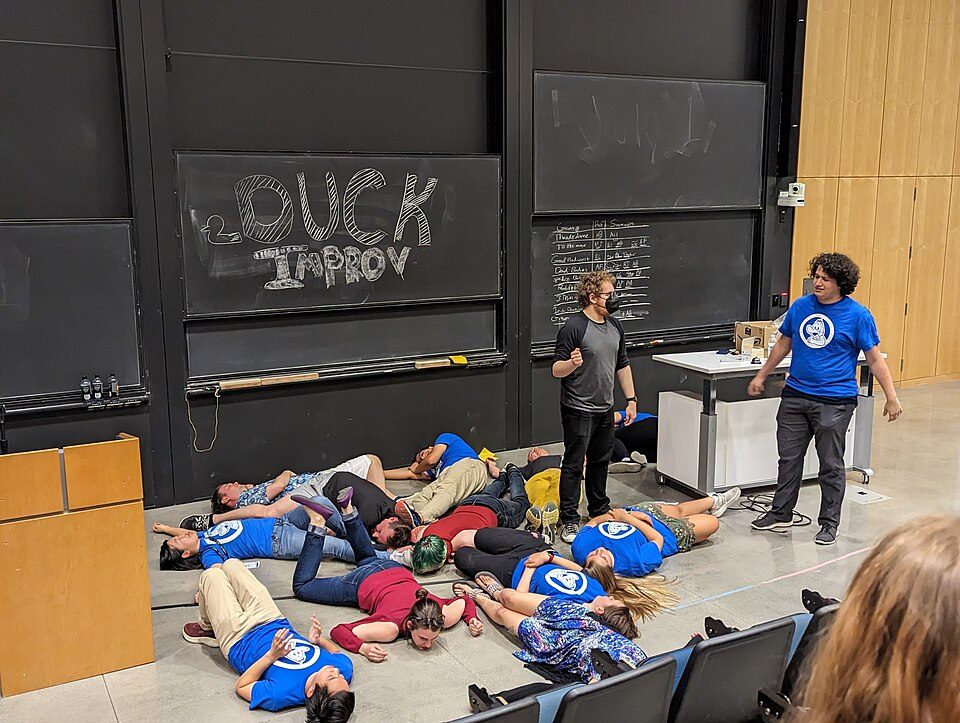

Search for community theatre groups and beginner improv classes near you; most run short courses for complete beginners.
Voice coaches
If you want focused, expert help with the voice itself (sound, accent, strain, confidence on camera), a voice coach or a speech pathologist can get you there faster than any club. Lesson 3 explains the difference and recommends two Australian coaches: Kirsten Geraghty at Vocal Impact and Sally Prosser.
Speech contests
Once you’ve got a few speeches behind you, contests are a great way to stretch. Preparing one speech to contest standard, polishing every line and pause over weeks, teaches you more about craft than ten ordinary speeches.
The best known is the Toastmasters International Speech Contest, which leads to the World Championship of Public Speaking. It starts in individual clubs; winners go on to area, division and district contests, then quarterfinals, semifinals and a final of eight speakers. Speeches run five to seven minutes, and thousands of members from over 100 countries enter each year. Clubs also run contests for evaluation, humorous speeches and Table Topics, depending on the season. You don’t have to win to benefit: getting through a club contest is an achievement in itself. Past winners’ speeches are on YouTube and well worth watching for craft.
The speaking circuit
Some people go further and make speaking part of their living, or all of it:
- Keynote speakers open or close conferences, usually on a topic they’re known for: an expertise, an achievement, or a story.
- MCs and hosts run conferences, awards nights and events.
- Trainers and facilitators run workshops for companies and associations.
- After-dinner speakers entertain at functions and fundraisers.
Fees range from nothing (talks you give to build a reputation) to many thousands of dollars per talk for well-known names, and a few experienced professionals earn very well from it. Several World Champions of Public Speaking, for example, went on to paid speaking careers. The path usually looks like this: speak free and often (community groups, industry associations, meetups, your own workplace), get good recordings, become known for one clear topic, and build up referrals and, later, speaker bureaus. This is general practice, not a guarantee: like any performing career, it’s competitive, and a strong topic matters as much as strong delivery.
You don’t need to want any of this to benefit from the course. But if you find you love it, the door is open.
Exercise 16
Choose one next step and put it in your calendar this week: visit a club as a guest, try a community choir rehearsal, sign up for a beginner improv or theatre class, ask someone to be your mentor, offer to mentor someone, book a session with a coach, or watch three World Championship final speeches and note one technique from each.
Sources
- Toastmasters International, Club meeting roles, Mentoring, Pathways, World Championship of Public Speaking and Find a club
- Rostrum Australia, rostrum.com.au
- Felsman, Gunawardena and Seifert (2020), Improv experience promotes divergent thinking, uncertainty tolerance, and affective well-being, Thinking Skills and Creativity
- Krueger, Murphy and Bink (2017), Thera-prov: a pilot study of improv used to treat anxiety and depression, Journal of Mental Health
- Allen et al. (2004), Career benefits associated with mentoring for protégés: a meta-analysis, Journal of Applied Psychology
- Eby et al. (2008), Does mentoring matter? A multidisciplinary meta-analysis comparing mentored and non-mentored individuals, Journal of Vocational Behavior
- Ghosh and Reio (2013), Career benefits associated with mentoring for mentors: a meta-analysis, Journal of Vocational Behavior
- Fiorella and Mayer (2013), The relative benefits of learning by teaching and teaching expectancy, Contemporary Educational Psychology