
Speaking with Confidence
Lesson 9: Facilitating small meetings
Goal: run a 30-minute meeting that starts on time, hears from everyone, and ends with clear decisions and actions.
Why the facilitator matters
When researchers gave small groups a range of tasks, some groups did well across the board. The best-performing groups weren’t the ones with the smartest members. They were the ones where people took roughly equal turns speaking and were better at reading each other; groups dominated by a few voices did worse (Woolley and colleagues, 2010). Some evidence: a well-known study, though later work has debated how strong the “collective intelligence” factor is.
Running a meeting well is mostly about making that happen: giving the quiet people room and keeping the loud ones in check. That’s a speaking skill, but the voice you use most is a calm, steady one that asks and steers.
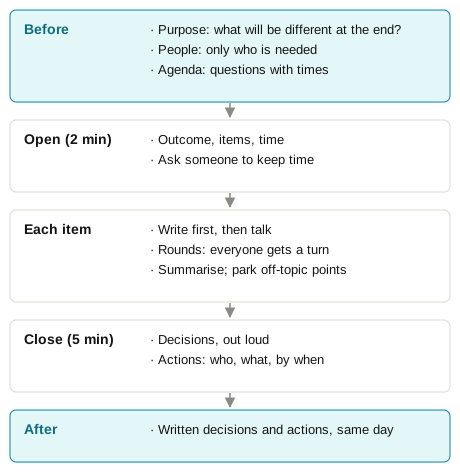
Before: purpose, people, plan
- Purpose: what will be different at the end? “Decide the event date and venue” beats “Discuss the event”.
- People: invite only those who need to decide, contribute or carry out the work.
- Plan: a short agenda, with each item written as a question and a time: “Which venue? (10 min)”.
- If it could be an email, send an email.
Open the meeting well
The first two minutes set the tone. Speak a little slower and louder than usual.
“Thanks for coming. We’ve got 30 minutes, and by the end I’d like us to have picked a date and a venue. Three items: dates, venues, then who does what. Sarah, can you keep an eye on the time for us?”
Starting on time, every time, teaches people to arrive on time.
Get everyone heard
- Round the table: for important questions, go around and ask each person in turn. Let people pass, but ask.
- Ask the quiet ones directly, and gently: “Jo, you know the venues best. What do you think?”
- Write first, then talk: give everyone two minutes to jot ideas on their own before discussing. Classic brainstorming studies found that groups shouting out ideas together produced fewer ideas than the same number of people working alone; people wait their turn, forget, or hold back (Diehl and Stroebe, 1987). Good evidence.
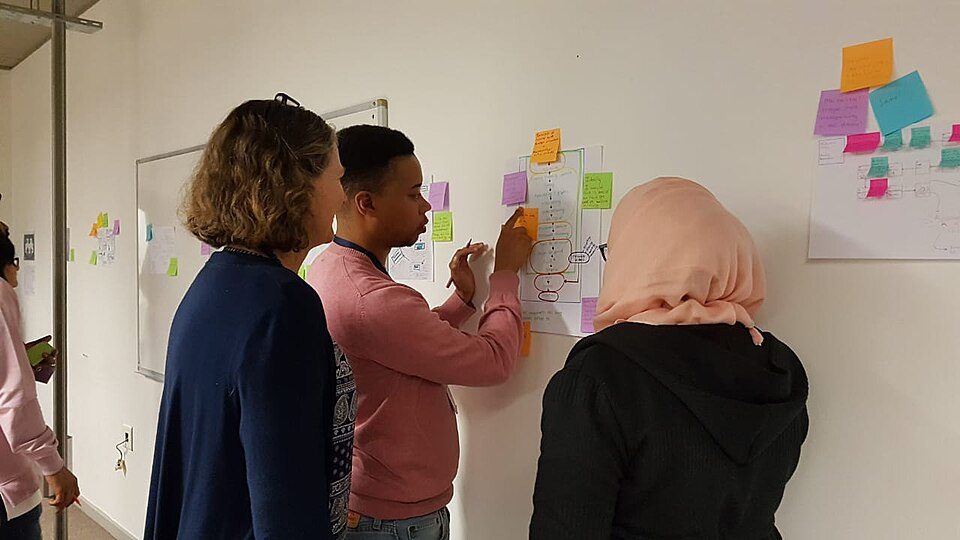

- Go to the most junior person first on opinion questions, so they aren’t just echoing the boss.
Manage the talkers
Most dominant speakers don’t realise it. Steer them kindly:
- “Thanks, Mark. Let’s hear from someone who hasn’t spoken yet.”
- “Can you sum that up in one sentence for the notes?”
- “That’s important, but it’s not on today’s agenda. Let’s park it and come back to it.” (Keep a visible “parking lot” list.)
Keep it moving
- Summarise often: “So far I’m hearing two options: the hall or the club. Is that right?”
- Watch the time out loud: “We’ve got five minutes left on this one.”
- When the discussion goes round in circles, name it and propose a way to decide: “We’ve covered this. Shall we vote, or shall Ali and I come back with a recommendation?”
Close with decisions and actions
Leave five minutes for this. Never skip it.
“So, we’ve decided: Saturday the 14th, at the bowling club. Actions: Ali books the venue by Friday, Sarah sends the invitation next week, I’ll sort the catering. Anything I’ve missed?”
Then send those decisions and actions in writing the same day, in three or four lines.
Online and hybrid meetings
Everything above matters more online, because it’s harder to jump in. Use people’s names to hand over, use the chat or “raise hand” features, and in hybrid meetings ask the remote people first so they aren’t forgotten. Lesson 12 has more.
Exercise 9
Take a meeting you run (or offer to run one). Write a one-line purpose, an agenda of questions with times, and an opening script. In the meeting, use a round for at least one item and close with a spoken summary of decisions and actions. Note in your log what changed.
Sources
- Woolley et al. (2010), Evidence for a collective intelligence factor in the performance of human groups, Science
- Diehl and Stroebe (1987), Productivity loss in brainstorming groups: toward the solution of a riddle, Journal of Personality and Social Psychology