
Speaking with Confidence
Lesson 5: Speaking off the cuff
Goal: answer a question you didn’t see coming with a clear point, a reason and a clean finish.
Most speaking is unplanned
“What do you think?” “Can you give us a quick update?” “Would you like to say a few words?” Most of what we say happens without a script, so it’s worth practising on purpose.
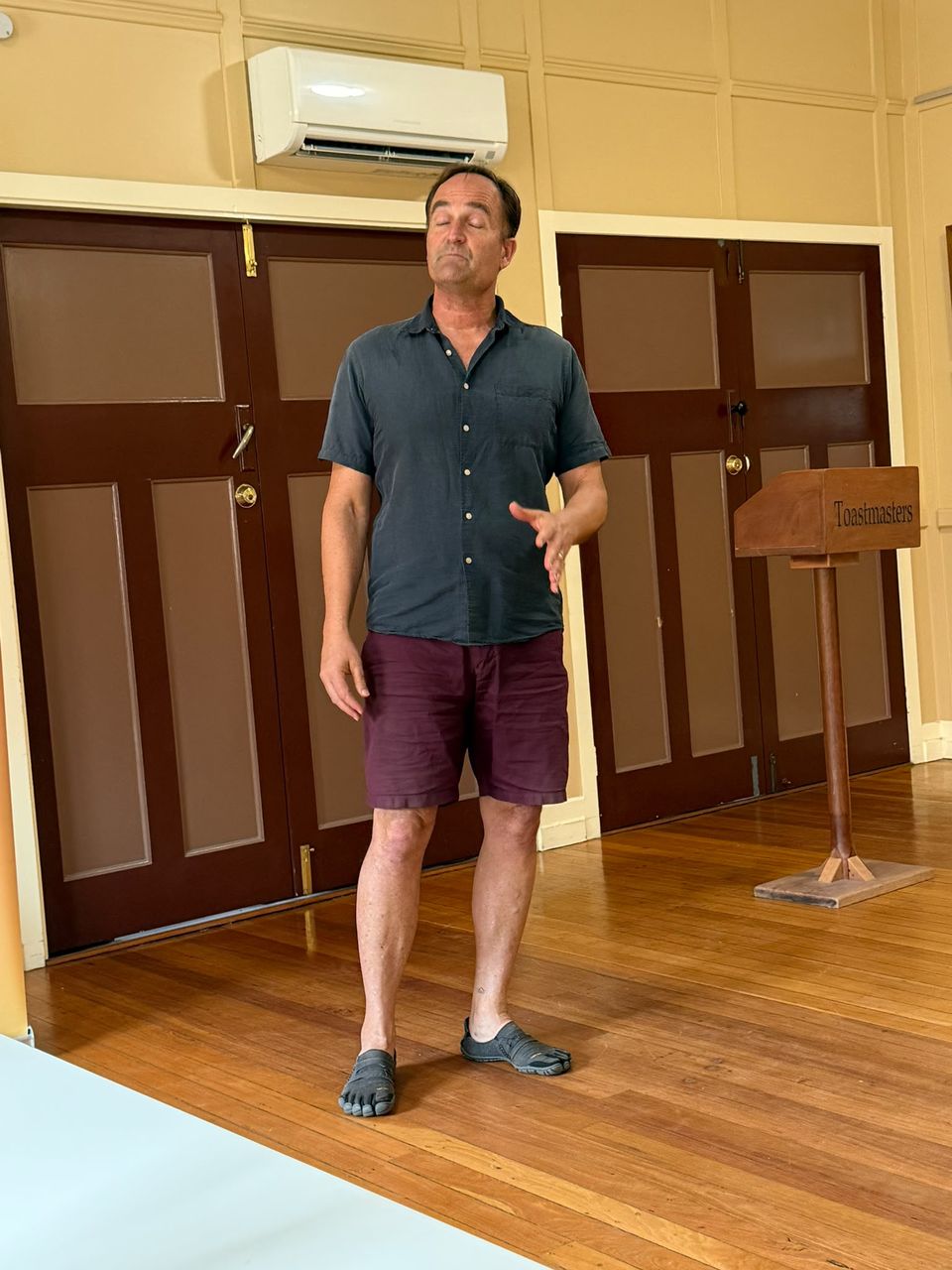
Why clubs do Table Topics
Toastmasters clubs have a segment called Table Topics (other speaking clubs run something similar under different names). A Topicsmaster calls on members one at a time (and guests who’d like a go), and gives each a question they haven’t seen: “What’s the best advice you’ve ever ignored?” or “If you could add one subject to every school, what would it be?” You stand up straight away and speak for one to two minutes, no notes. A timer shows green, amber and red lights, and many clubs vote for the best answer of the night.
It can look like a party game. It’s actually the most practical training in the meeting, for a few reasons:
- It’s the skill you use most. Work and life are full of unplanned questions; prepared speeches are rare.
- It’s low stakes and frequent. Two minutes, in a friendly room, every fortnight: exactly the gradual, repeated exposure that reduces speaking anxiety (Lesson 2).
- It trains structure under pressure. You learn to grab a shape (like the ones below), make one point and stop on time.
- It teaches you that you survive. Most people’s first Table Topic is far better than they expected. That discovery is worth more than any tip.
- Everyone gets a turn. Members with no speech that night still speak.
You don’t need a club to do this (see the end of this lesson), but a club makes it a habit. Lesson 16 explains the rest of the meeting.
Buy a moment
You’re allowed to think before you answer.
- Pause, breathe out, and look as if you’re thinking (because you are).
- Repeat or rephrase the question: “So, what would I change about the rollout?”
- Say what’s happening: “Good question. Let me think about that for a second.”
A thoughtful pause makes you look more considered, not less.
Pick a simple shape
You don’t need clever words. You need a structure to hang them on. Learn two or three of these until they’re automatic. All are practitioner tips, used by speaking coaches and clubs for decades.
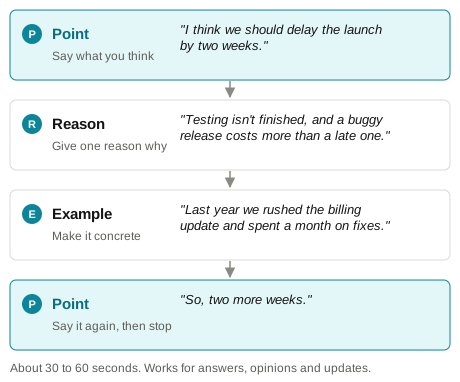
PREP: Point, Reason, Example, Point
“I think we should delay the launch by two weeks. (Point) The testing isn’t finished, and a buggy release costs more than a late one. (Reason) Last year we rushed the billing update and spent a month on fixes. (Example) So, two more weeks. (Point)”
Past, present, future
“When I started here, we did everything on paper. Now about half of it is online. In a year I’d like the whole process to be digital.”
What, so what, now what
“Sales dropped 8% last month. (What) That’s mostly the north region losing two big accounts. (So what) I’d like us to call both of them this week. (Now what)”
Problem, solution, benefit: good for proposals and suggestions.
Say one thing, then stop
The biggest off-the-cuff mistake isn’t freezing. It’s rambling: circling the point, adding “and another thing”, and ending with “…so, yeah”. Decide your final sentence while you’re still talking, usually a restatement of your point, then say it and stop. Silence after your last word is fine.
When you don’t know
“I don’t know” is a complete answer, especially followed by what you’ll do: “I don’t know the exact figure. I’ll check and send it to you this afternoon.” Guessing confidently and getting it wrong costs far more credibility than an honest gap.
Practise in tiny doses
This is a skill you can train like a muscle: short reps, often.
- Put a list of random topics in your phone (holidays, your first job, a book you’d recommend, the best meal you’ve had, something you changed your mind about).
- Once a day, pick one at random, set a timer for 90 seconds, and talk out loud using PREP or past-present-future.
- In the car, on a walk, in the shower: no audience needed.
Exercise 5
Do three 90-second off-the-cuff answers this week using the topic list. Record at least one. Listen for: did you state your point in the first two sentences, and did you stop cleanly?
Sources
- Abrahams, Think Fast, Talk Smart: Communication Techniques, Stanford Graduate School of Business (video)
- Stanford GSB, Think Fast, Talk Smart podcast
- Toastmasters International, Club meeting roles (Table Topics, Topicsmaster, Timer)
- Ebrahimi et al. (2019), Psychological interventions for the fear of public speaking: a meta-analysis, Frontiers in Psychology