
Speaking with Confidence
Lesson 11: Feedback, evaluation and listening
Goal: get one specific evaluation of your speaking this week, and give one piece of useful feedback to someone else.
Practice alone isn’t enough
You can speak in meetings for 30 years and not get much better. Repetition on its own mostly makes habits stick, good and bad. Studies of how people become expert found that improvement comes from deliberate practice: focused work on a specific weakness, with fast feedback on how you went (Ericsson and colleagues, 1993). How much deliberate practice explains is debated, and a later meta-analysis found it matters less in some fields than first claimed (Macnamara and colleagues, 2014). But the core idea holds up: practice with feedback beats practice without it.
Across education research, feedback is one of the strongest influences on learning. It works best when it answers three questions: where am I going, how am I going, and what should I do next? It works worst when it’s about the person (“you’re a natural”) rather than the task (Hattie and Timperley, 2007). Good evidence.
The catch: most of us never get specific feedback on how we speak. Colleagues say “good presentation” or nothing at all. So you have to ask for it, or go somewhere it’s built in.
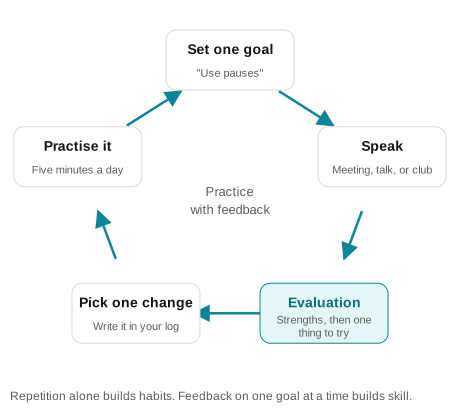
How a club evaluation works
In Toastmasters and similar clubs, every prepared speech is followed by a short spoken evaluation from another member, in front of the whole club. It’s the heart of the format, and the main reason people improve there faster than in years of work meetings. A typical evaluation goes like this:
- Before the speech, the speaker tells the evaluator what they’re working on: “I’m trying to use pauses and cut my ‘ums’”, or the goals of the project they’re doing.
- During the speech, the evaluator listens and takes notes on those goals and anything else that stands out.
- Straight after, the evaluator gives a two to three minute spoken evaluation, usually in a commend, recommend, commend shape:
- Commend: specific strengths to keep. “Your pause before the punchline made the whole room lean in.”
- Recommend: one or two things to try next time, not ten. “I’d like to hear your opening without notes. You clearly know it.”
- Commend: finish with the overall strength and encouragement.
- Evaluators speak from their own view: “I found…”, “For me…”, not “You should never…”. It’s one listener’s honest reaction, not a verdict.
- Someone evaluates the evaluators. A general evaluator reviews the whole meeting, including how useful each evaluation was.
Does commend, recommend, commend contradict the warning below about the “feedback sandwich”? Not really. In a club, the speaker asked for the feedback and set the goals, the strengths are genuine lessons (what to keep doing), and everyone in the room shares the format. The sandwich backfires at work when praise is used as padding around a correction nobody asked for. Practitioner framework, refined by clubs over decades.
Evaluating is a skill too
Speakers often find they learn as much from giving evaluations as from getting them. To evaluate well, you have to listen closely, pick out the two or three things that matter most, and then give a structured two-minute talk with almost no preparation, kindly and honestly, in front of the person you’re evaluating. That’s listening, judgement, impromptu speaking and tact all at once: the skills of a good manager. Practitioner tip.
Bring evaluation to work
- Ask for a specific evaluation. Before a presentation or meeting: “Could you watch for one thing: do I get to my point quickly? Tell me one thing that worked and one thing to try next time.” Specific requests get specific answers.
- Run a two-minute review at the end of meetings you lead: “What worked today? What should we do differently next time?”
- Evaluate yourself on recordings (Lessons 3 and 13) using the same shape: one thing to keep, one thing to try.
Giving feedback people can use
Feedback can make things worse. A large review of feedback studies found that in about a third of cases, feedback actually reduced performance, mostly when it shifted attention from the task to the person (“you’re careless” rather than “these three figures were wrong”) (Kluger and DeNisi, 1996). Good evidence.
A simple structure many workplaces use is situation, behaviour, impact (from the Center for Creative Leadership; practitioner framework):
- Situation: “In this morning’s client meeting…”
- Behaviour: what you saw or heard, not what you think it means: “…you answered their pricing question with the exact figures…”
- Impact: “…and they agreed to the quote on the spot.”
It works for corrections too: “In Tuesday’s handover (situation), the patient’s allergy wasn’t mentioned (behaviour). The night nurse nearly gave the wrong medicine (impact). What happened?” End with a question, then listen.
A few more habits:
- Give more positive feedback than you think you need to, and make it just as specific.
- Give corrections in private, soon, and one at a time.
- Don’t wrap an unrequested correction in praise. People learn to brace for the middle and discount the praise. Be direct and warm instead.
Receiving feedback
- Say thank you, even when it stings. Then stop talking. In a club you don’t reply to your evaluation, and that’s a good rule anywhere.
- Ask for an example if it’s vague: “Can you tell me when you noticed that?”
- You don’t have to agree straight away. “Let me think about that” is fine.
- Pick one recommendation to work on next time. Write it in your speaking log.
Listening is half of it
You can’t evaluate, lead or answer well without listening first. Good listening also changes how the other person speaks: in workplace studies, people who felt properly listened to were less defensive, thought more clearly and were more open to other views (Kluger and Itzchakov, 2022). Some evidence, growing fast.
- Stop doing other things. Laptop closed, phone face down.
- Let them finish. Count to two after they stop before you start.
- Check you’ve got it: “So the main problem is the handover, not the software. Have I got that right?”
- Ask before you advise: “Do you want ideas, or do you mainly want to talk it through?”
- Ask one more question than feels natural: “What else?”
Exercise 11
Before your next meeting or talk, ask one person to evaluate you on one specific goal, using commend, recommend, commend. Thank them, and write their recommendation in your log. Then give one person some positive feedback using situation, behaviour, impact.
Listen
Conversations from the Legendary Lectures podcast, hosted by Al Barnett on the Gold Coast. These are personal stories and practitioner views, not research.
- Legendary Lectures #24, Laughing Together: How Listening and Humour Bridge Political Divides with Steve Dalton and Mr X: listening, humour and talking across political divides, featuring the course author.
Sources
- Ericsson, Krampe and Tesch-Römer (1993), The role of deliberate practice in the acquisition of expert performance, Psychological Review
- Macnamara, Hambrick and Oswald (2014), Deliberate practice and performance in music, games, sports, education, and professions: a meta-analysis, Psychological Science
- Hattie and Timperley (2007), The power of feedback, Review of Educational Research
- Kluger and DeNisi (1996), The effects of feedback interventions on performance: a historical review, a meta-analysis, and a preliminary feedback intervention theory, Psychological Bulletin
- Kluger and Itzchakov (2022), The power of listening at work, Annual Review of Organizational Psychology and Organizational Behavior
- Toastmasters International, Club meeting roles