
Speaking with Confidence
Lesson 7: Stories and examples
Goal: find three short stories of your own and tell one in under a minute.
Why stories work
When people are absorbed in a story, they tend to accept its point more readily and argue with it less. Researchers call this “transportation” (Green and Brock, 2000). Good evidence: it’s been replicated many times. A specific example also makes an abstract point concrete: “customer service matters” is forgettable; the customer who drove back 40 minutes to return a $3 part isn’t.
You don’t need dramatic stories. Small, specific, true ones are better.
Where to find yours
Keep a list. Good sources:
- A mistake you made and what it taught you
- A first: first job, first time leading a team, first time in another country
- A time someone helped you, or you helped someone
- A customer, patient, student or client moment (change the details to protect them)
- Something you changed your mind about
Each one can illustrate several points. The mistake story might be about preparation, or about asking for help, or about honesty, depending on what you need.
A simple shape
| Step | Question | Length |
|---|---|---|
| Situation | Where, when, who? | One or two sentences |
| Problem | What went wrong, or what was at stake? | One or two sentences |
| What happened | What did you (or they) do? | A few sentences |
| Point | So what? What does it show? | One sentence |
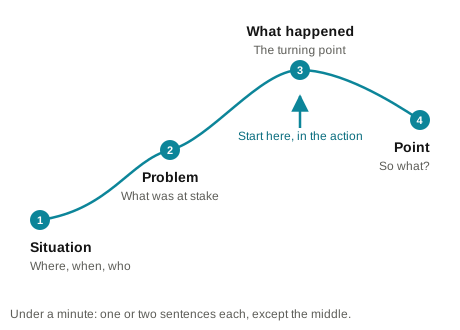
Start in the middle of the action: “It was 6 am, and the client was already on the phone.” Skip the long run-up (“So, this was back in maybe 2015, or 2016…”).
Details that make it real
One or two specific details do a lot: a time, a place, a number, a word someone actually said. “She looked at the spreadsheet and said, ‘Who signed this off?’” is stronger than “my manager wasn’t happy”.
Don’t add so many details that the point gets lost. If a detail doesn’t help the listener picture it or feel it, cut it.
Voice your characters
This is where you can borrow from actors. When someone in your story speaks, don’t report it (“my boss said I needed to hurry up”). Become them for a line: “She leaned over the desk and said, ‘I need it by five. Not five past. Five.’”
- Change your voice for each character: a bit higher or lower, faster or slower, louder or quieter. That alone is vocal variety (Lesson 3), and it makes dialogue easy to follow without “he said, she said”.
- Use a touch of an accent when it’s part of who the character is: your Scottish grandfather, the Texan client, the Kiwi tour guide. A light hint is enough. It adds colour, and audiences love it.
- Change your body too: turn your head slightly for each person in a conversation, so the audience can see who’s talking. Actors call this using different focus points.
- Commit to it. A character done half-heartedly is more awkward than one done fully. You don’t need to be a great actor; you need to not apologise for trying.
Keep accents and impressions affectionate. Never use an accent to make a group of people the joke. If you’re not sure how it will land, describe the person instead of imitating them.
Stories at work
You don’t need permission to use a story in a meeting. Short ones work everywhere:
- Job interviews: most “tell me about a time when” questions want a story (situation, task, action, result).
- Proposals: one example of the problem makes the case faster than three charts.
- Feedback and coaching: “I had the same issue in my first year…” builds trust.
Exercise 7
Write down three stories from your own life using the shape above, in note form. Pick one and tell it out loud, timed, in under 60 seconds. Then tell it to someone this week: a friend, a colleague, at dinner. Notice where they react.
Listen
Conversations from the Legendary Lectures podcast, hosted by Al Barnett on the Gold Coast. These are personal stories and practitioner views, not research.
- Legendary Lectures #2, Unveiling the Power of Stories with Katrina Hahling: a storyteller and publisher on why stories stay with us.
- Legendary Lectures #35, Unlock Your Potential by Rewriting Your Story with Carrie KC West: how the stories we tell about ourselves shape how we lead and speak.
Sources
- Green and Brock (2000), The role of transportation in the persuasiveness of public narratives, Journal of Personality and Social Psychology