
Speaking with Confidence
Lesson 4: Body, eyes and space
Goal: stand (or sit) steady, let your hands help you, and look at people long enough to connect.
Stance: grounded, not stiff
Standing:
- Feet about hip-width apart, weight even on both feet.
- Knees soft, not locked.
- Stop swaying, rocking or shifting from foot to foot. If you want to move, walk a few steps on purpose, then stop and plant again.
Sitting at a table:
- Sit forward, back off the chair, forearms on the table.
- Keep your hands visible, not under the table or wrapped around a coffee cup.
- Lean in slightly when you speak. It signals that you are joining the conversation, not watching it.
Let your hands move
Gestures aren’t decoration. They help you think. In one study, people explaining maths problems remembered more of an unrelated memory task when they were allowed to gesture than when they had to keep their hands still (Goldin-Meadow and colleagues, 2001). Good evidence that gesturing eases the load of speaking.
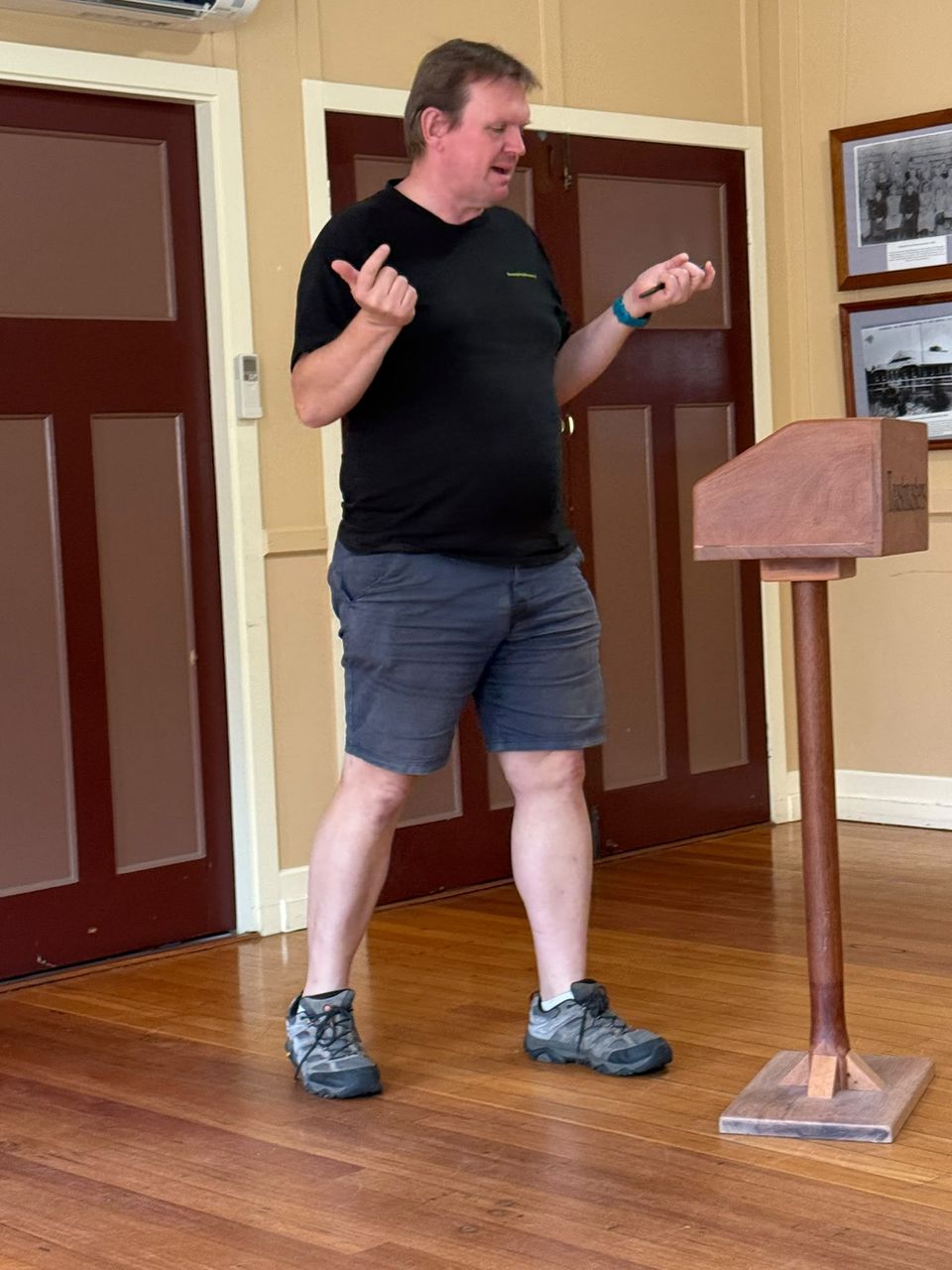
So don’t clamp your hands together or bury them in your pockets. Start with your hands loosely together at waist height, and let them go when you have something to show: size, direction, a list (“first… second…”), a contrast (“on one hand… on the other…”). Bigger rooms need bigger gestures.
Eye contact: one person, one thought
In a group, look at one person for a whole thought (a sentence or two), then move to someone else. Avoid scanning back and forth like a lighthouse, staring at the slides, or talking only to the most senior person in the room.
In a meeting, include the quiet end of the table too. On video, look at the camera for your key points (Lesson 12).
About power posing
You may have seen a famous TED talk recommending “power poses” (standing like Wonder Woman for two minutes) to boost confidence and change your hormones. The original study (Carney, Cuddy and Yap, 2010) reported changes in hormones and risk-taking. A larger replication found no effect on hormones or behaviour (Ranehill and colleagues, 2015), and one of the original authors has said she no longer believes the effect is real.
A later review argued that open, upright postures may still make people feel a bit more confident (Cuddy and colleagues, 2018). So: Early evidence for a small effect on how you feel; no good evidence it changes your hormones or how others see you. Standing tall before you speak is harmless and may help a little. It isn’t a substitute for preparation.
Use the space
- Get to the room early. Stand where you’ll speak; sit where you’ll sit.
- Move things that block you: a laptop lid between you and the group, a lectern you don’t need.
- In a meeting, where you sit matters. The middle of the long side of the table makes it easier to be heard and seen than the far corner.
Read more
Body language is more than hands and eyes: facial expression, posture, touch, personal space and even how you use time all send signals. Verywell Mind has a clear, practical overview of the types of nonverbal communication.
Exercise 4
In your next meeting, try two things: keep your hands on the table and let them gesture when you speak, and hold eye contact with one person for a full sentence before moving on. Note in your log whether anyone responded differently.
Sources
- Verywell Mind, Types of nonverbal communication (facial expression, gesture, paralinguistics and more)
- Goldin-Meadow et al. (2001), Explaining math: gesturing lightens the load, Psychological Science
- Carney, Cuddy and Yap (2010), Power posing: brief nonverbal displays affect neuroendocrine levels and risk tolerance, Psychological Science
- Ranehill et al. (2015), Assessing the robustness of power posing: no effect on hormones and risk tolerance in a large sample of men and women, Psychological Science
- Cuddy, Schultz and Fosse (2018), P-curving a more comprehensive body of research on postural feedback reveals clear evidential value for power-posing effects, Psychological Science