
Jazz Piano for Classical Players
Lesson 2: Seventh chords, the jazz colour palette
Goal: build the five seventh chords on any note without thinking, and know which ones belong to a key.
Why sevenths
Classical harmony treats a triad as the basic chord and adds a seventh now and then. Jazz flips it: the four-note seventh chord is the basic unit, and a plain triad sounds bare, even a bit old-fashioned. Add one note on top of each triad and you’re most of the way to a jazz sound.
The five qualities
Build each one on C first. Each is a triad plus a seventh.
| Chord | Formula | On C | Sound |
|---|---|---|---|
| Major 7 (Cmaj7) | 1 3 5 7 | C E G B | Warm, dreamy, “home” |
| Dominant 7 (C7) | 1 3 5 b7 | C E G Bb | Bluesy, wants to move |
| Minor 7 (Cm7) | 1 b3 5 b7 | C Eb G Bb | Mellow, relaxed |
| Half-diminished (Cm7b5) | 1 b3 b5 b7 | C Eb Gb Bb | Dark, unsettled |
| Diminished 7 (Cdim7) | 1 b3 b5 bb7 | C Eb Gb A | Tense, spooky, symmetrical |
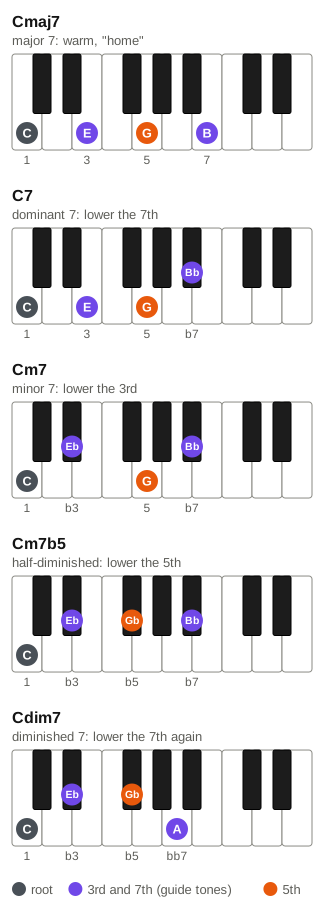
A quick way to remember them is to change one note at a time, starting from Cmaj7:
- Cmaj7 C E G B → lower the 7th → C7 C E G Bb
- C7 → lower the 3rd → Cm7 C Eb G Bb
- Cm7 → lower the 5th → Cm7b5 C Eb Gb Bb
- Cm7b5 → lower the 7th again → Cdim7 C Eb Gb A
Play that sequence slowly and listen to the chord get darker at each step.
Two more you’ll see often:
- C6 (C E G A) is a major triad with a 6th. It’s used instead of Cmaj7 for a sweeter, older sound, and at the ends of tunes.
- Cm6 (C Eb G A) is the classic sound of a minor key’s home chord in jazz.
The chords that live in a key
Stack thirds on each note of the C major scale, using only white notes, and you get seven seventh chords:
| Degree | I | ii | iii | IV | V | vi | vii |
|---|---|---|---|---|---|---|---|
| Chord | Cmaj7 | Dm7 | Em7 | Fmaj7 | G7 | Am7 | Bm7b5 |
| Quality | major 7 | minor 7 | minor 7 | major 7 | dominant 7 | minor 7 | half-dim |
That pattern is the same in every major key: maj7 on I and IV, m7 on ii, iii and vi, dominant 7 on V, m7b5 on vii. Only V gets a dominant 7. That’s why the dominant chord always tells you where “home” is.
Jazz musicians name chords by these Roman numerals so they can talk about any key at once. “A ii-V in F” means Gm7 to C7. You’ll use that constantly from Lesson 4.
Inversions, briefly
Your classical training already covers inversions. A seventh chord has four positions (root position plus three inversions), and in jazz you’ll mostly pick whichever one sits closest to the chord before it. That’s called voice leading and it’s the secret of smooth jazz harmony. Lesson 3 makes it easy.
Exercise 2
Pick three roots: C, F and Bb. On each one, play the five qualities in the order above (maj7, 7, m7, m7b5, dim7), right hand only, root position, slowly. Say each chord name out loud as you play it. Then try the same on G, D and Eb. Aim for five roots by the end of the week; all twelve can wait.
Sources
- Mark Levine (1989), The Jazz Piano Book, Sher Music, chapter 1
- Mark Levine (1995), The Jazz Theory Book, Sher Music, chapters 1 and 2 (chord types and the major scale harmonised)