
Jazz Piano for Classical Players
Lesson 6: Rootless voicings, the Bill Evans sound
Goal: play a ii-V-I with four-note rootless voicings in both positions, and know when to use them.
Leave out the root. Really.
This is the lesson that will feel most wrong to your classical brain, and it’s the one that makes the biggest jump in sound.
In the late 1950s, pianists such as Bill Evans and Wynton Kelly started leaving the root out of their left hand entirely. The bass player was already playing it, so why double it? Instead the left hand plays the 3rd and 7th (the guide tones from Lesson 4) plus two colour notes: the 9th, and either the 5th or the 13th.
The result is a rich, close, four-note chord sitting around middle C. It’s the sound of most modern jazz piano.


Two numbers you need first:
- The 9th is the 2nd, an octave up. On C, that’s D.
- The 13th is the 6th, an octave up. On C, that’s A.
Two positions: A and B
Every rootless voicing comes in two positions, named by jazz educators as A and B:
- A form: 3rd at the bottom. 3 5 7 9 (or 3 13 7 9 on a dominant).
- B form: 7th at the bottom. 7 9 3 5 (or 7 9 3 13 on a dominant).
They’re the same four notes, just inverted. You choose whichever sits closer to the chord before it, so your hand stays around middle C.
The ii-V-I, version 1 (start with A)
In C major, starting with the A form on Dm7:
| Chord | Plays as | Form | LH notes (low to high) |
|---|---|---|---|
| Dm7 | Dm9 | A | F A C E |
| G7 | G13 | B | F A B E |
| Cmaj7 | Cmaj9 | A | E G B D |
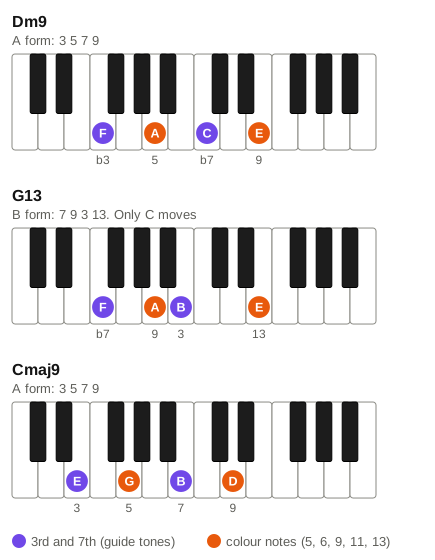
Play those three slowly. Notice that from Dm9 to G13 only one note moves (C down to B). That’s the guide tone rule again. Then three notes step down to the Cmaj9.
The ii-V-I, version 2 (start with B)
Same progression, other starting position, about four notes higher:
| Chord | Plays as | Form | LH notes (low to high) |
|---|---|---|---|
| Dm7 | Dm9 | B | C E F A |
| G7 | G13 | A | B E F A |
| Cmaj7 | Cmaj9 | B | B D E G |
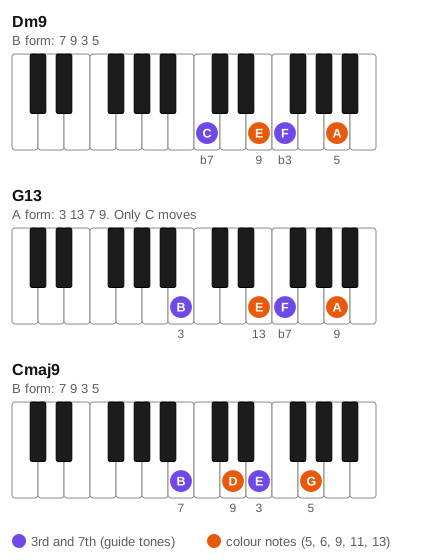
Again, one note moves into the G13, and the whole thing glides.
In other keys
The same patterns transposed. Version 1 (A, B, A):
| Key | ii (A) | V (B) | I (A) |
|---|---|---|---|
| F | Gm9: Bb D F A | C13: Bb D E A | Fmaj9: A C E G |
| Bb | Cm9: Eb G Bb D | F13: Eb G A D | Bbmaj9: D F A C |
| Eb | Fm9: Ab C Eb G | Bb13: Ab C D G | Ebmaj9: G Bb D F |
Where to play them
Keep rootless voicings roughly between the D below middle C and the G above middle C. That’s the sweet spot. Lower and they get muddy; higher and they get thin. If a voicing drifts out of range, switch it to the other form.
Minor ii-V-i, rootless
In C minor, a smooth set:
| Chord | LH notes (low to high) | Colour |
|---|---|---|
| Dm7b5 | F Ab C D | This one keeps the root: it’s easier and sounds better |
| G7alt | F Ab B Eb | b7, b9, 3, b13 |
| Cm9 | Eb G Bb D | b3, 5, b7, 9 |
That G7 is an altered dominant (Lesson 7): its flat 9 and flat 13 make it sound tense and dark before it resolves.
When to play the root
Rootless voicings assume someone else is playing the bass. On your own:
- Play a low root on beat 1 with your left hand, then jump up to the rootless voicing on beat 2 or the “and” of 2 (a lighter cousin of stride piano), or
- Play the rootless voicing in the left hand and the melody in the right, and accept the gap. It still sounds good, because the guide tones make the harmony clear.
Using iReal Pro or a play-along with bass (Lesson 14) is the best way to hear rootless voicings in context.
Exercise 6
Learn version 1 of the ii-V-I in C until you can play it without looking. Then version 2. Then play the circle sequence from Lesson 3 (Am7 Dm7 G7 Cmaj7 Fmaj7 Bm7b5 E7 Am7) with a bass line from an app or a recording under you, using rootless voicings, choosing A or B each time to keep your hand near middle C. For Bm7b5 use D F A B; for E7 use D F# G# C (E7 with a b13).
Sources
- Mark Levine (1989), The Jazz Piano Book, Sher Music, chapter 4 (left hand voicings, A and B forms)
- Earl MacDonald, Rootless left hand piano voicings
- Noah Kellman (YouTube), How to Create Your Own Rootless Voicings