
Jazz Piano for Classical Players
Lesson 3: Shell voicings, your first shortcut
Goal: play any seventh chord in the left hand using just three notes, and move between chords with almost no hand movement.
The idea: keep only the notes that matter
A seventh chord has four notes, but they don’t all do the same job:
- The root tells you which chord it is.
- The 3rd tells you major or minor.
- The 7th tells you which kind of seventh chord.
- The 5th tells you almost nothing. In most chords it’s the same in major, minor and dominant. Leave it out and nobody notices.
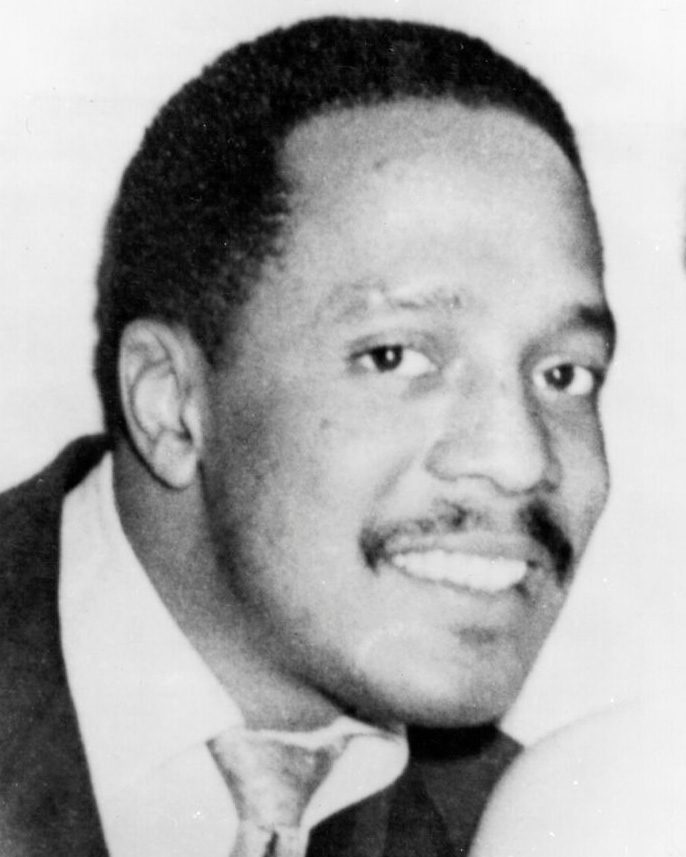
So drop the 5th. What’s left (root, 3rd and 7th) is a shell voicing. It sounds open and modern, it’s easy to grab, and it leaves room for your right hand to play the melody. Bud Powell, one of the founders of bebop piano in the 1940s, played this way, and it’s still the first voicing most jazz teachers give students.

Two shapes, that’s all
Every shell is one of two shapes in the left hand, with the root at the bottom:
- Shape A: root, 3rd, 7th (1-3-7). The 3rd sits just above the root and the 7th above that. A compact hand shape inside one octave.
- Shape B: root, 7th, 3rd (1-7-3). The 7th sits right above the root and the 3rd goes on top, above the octave.
Try both on C:
| Chord | Shape A (1-3-7) | Shape B (1-7-3) |
|---|---|---|
| Cmaj7 | C E B | C B E |
| C7 | C E Bb | C Bb E |
| Cm7 | C Eb Bb | C Bb Eb |
| Cm7b5 | C Eb Bb (add Gb if you like) | C Bb Eb |
| C6 | C E A | C A E |
Half-diminished chords are the one case where the 5th matters, because the flat 5 is what makes it half-diminished. Add it on top or in the right hand when you can.
Where to play them: keep the root in the octave below middle C, give or take a few notes. Go much lower and the 3rd turns to mud. Go higher and you’ll crash into your right hand.
The secret: alternate the shapes
Now the shortcut. When chords move by 4ths or 5ths (which they do most of the time in jazz), switch between Shape A and Shape B. The 3rd and 7th of one chord slide by a half step or stay put to become the 7th and 3rd of the next. Your hand barely moves.
Try Dm7 to G7 to Cmaj7:
| Dm7 | G7 | Cmaj7 | |
|---|---|---|---|
| Shape | A (1-3-7) | B (1-7-3) | A (1-3-7) |
| LH notes | D F C | G F B | C E B |
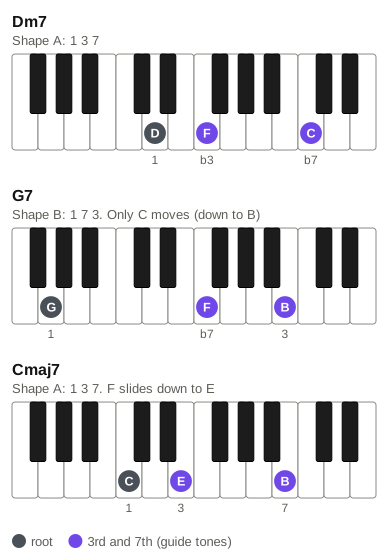
Look at the top two notes: F and C, then F and B, then E and B. Each step only one note moves, by a half step. That smoothness is the whole sound of jazz harmony, and you got it by playing fewer notes, not more.
Adding the melody
With the left hand on shells, the right hand plays the melody, one note at a time, an octave or so above middle C. That’s already a complete, legitimate way to play a jazz standard. Plenty of professionals play the first chorus of a tune exactly like this.
If a melody note clashes with the shell (say the melody is C and you’re playing a shell with B in it), move the shell’s top note out of the way, or drop it. The melody always wins.
A practice sequence: round the circle
This sequence runs through the chords of A minor and C major, moving by 4ths. It turns up in hundreds of tunes:
| Chord | Am7 | Dm7 | G7 | Cmaj7 | Fmaj7 | Bm7b5 | E7 | Am7 |
|---|---|---|---|---|---|---|---|---|
| LH | A C G | D C F | G B F | C B E | F A E | B A D | E G# D | A G C |
| Shape | A | B | A | B | A | B | A | B |
The E7 has a G#: it’s borrowed from A minor’s harmonic minor, which you’ll know from classical scales.
Exercise 3
Play the circle sequence above with the left hand only, four slow beats per chord with a metronome at 60. When it’s comfortable, add a right hand: just the 3rd or 7th of each chord held on top, an octave higher. Then try starting with Shape B on Am7 instead (A G C, D F C…) and alternating from there.
Sources
- Mark Levine (1989), The Jazz Piano Book, Sher Music, chapter 2 (three-note voicings)
- Jazz Tutorial, ii-V-I chord voicings for jazz piano
- Play Jazz Piano (YouTube), The ii-V-I with shell voicings in 12 major and minor keys