
Jazz Piano for Classical Players
Lesson 7: Extensions, alterations and upper structures
Goal: know which colour notes to add to each kind of chord, and use triads in the right hand over a left hand shell to get big, modern sounds without memorising huge chords.
Extensions: the notes above the 7th
Keep stacking thirds above a seventh chord and you get the extensions: the 9th, 11th and 13th. They’re just the 2nd, 4th and 6th an octave up. Jazz chord symbols like Dm11 or G13 are naming those notes.
You don’t need to play every note in the stack. A chord symbol is a menu, not an order. Lesson 6’s rootless voicings already slipped in 9ths and 13ths. Here’s what’s safe on each chord, and what to avoid:
| Chord | Add freely | Avoid (unless the chart asks) | Why |
|---|---|---|---|
| maj7 | 9, 13 (= 6), #11 | natural 11 | The 11 (F on C) grates against the 3rd (E) |
| m7 | 9, 11, 13 | (nothing much) | All the Dorian notes sound good |
| 7 (dominant) | 9, 13, or any alteration below | natural 11 | Same clash as maj7, unless it’s a sus chord |
| m7b5 | 9, 11 | b9 | The b9 is a half step above the root and sounds harsh |
The maj7#11 chord (Cmaj7 with an F#) is the dreamy, floating sound of a lot of modern jazz and film music. Try it: LH C E B, RH D F# A.
Sus chords
A sus chord replaces the 3rd with the 4th. On a dominant it’s written G7sus4, G9sus or sometimes F/G, and that last spelling gives away the easiest way to play it:
- LH: G (low)
- RH: F major triad (F A C)
That’s G, F, A and C: root, 7th, 9th and 11th (the sus 4). It’s an open, unresolved sound that Herbie Hancock built whole tunes on (“Maiden Voyage”, 1965). Use it instead of a ii-V: G7sus4 is basically Dm7 and G7 squashed into one chord.
Altered dominants: tension on purpose
A dominant 7 chord’s whole job is to create tension that resolves to the next chord. Jazz players turn that up by altering the 5th and 9th: raising or lowering them a half step.
On G7 the alterations are:
| Alteration | Note on G7 | Also called |
|---|---|---|
| b9 | Ab | |
| #9 | A# (often written Bb) | The “Hendrix” note |
| b5 / #11 | Db (C#) | |
| #5 / b13 | D# (often written Eb) |
A chord symbol like G7alt means “use any of these”, and G7(b9), G7(#9), G7(b13) name specific ones. Some rules of thumb:
- Going to a minor chord: altered dominants sound natural (the b9 and b13 are in the minor key’s scale).
- Going to a major chord: either works. Natural 9 and 13 sound sweet; altered sounds bluesy and tense.
- Keep the 3rd and 7th. They’re what make it a dominant. Alterations go on top.
Upper structure triads: the big shortcut
Here’s a trick that makes very complex-sounding chords easy. Hold a dominant 7 shell in the left hand, just the 3rd and 7th (or root and 7th), and play an ordinary major triad in the right hand. Which triad you choose decides the colour.
Over G7, with LH F B (7th and 3rd):
| RH triad | Notes | Adds | Chord name | Sound |
|---|---|---|---|---|
| A major | A C# E | 9, #11, 13 | G13(#11) | Bright, open, Lydian |
| E major | E G# B | 13, b9, 3 | G13(b9) | Dramatic, classic big band |
| Eb major | Eb G Bb | b13, root, #9 | G7(#9, b13) | Dark, tense, “altered” |
| Db major | Db F Ab | b5, 7, b9 | G7(b9, b5) | Diminished, very tense |
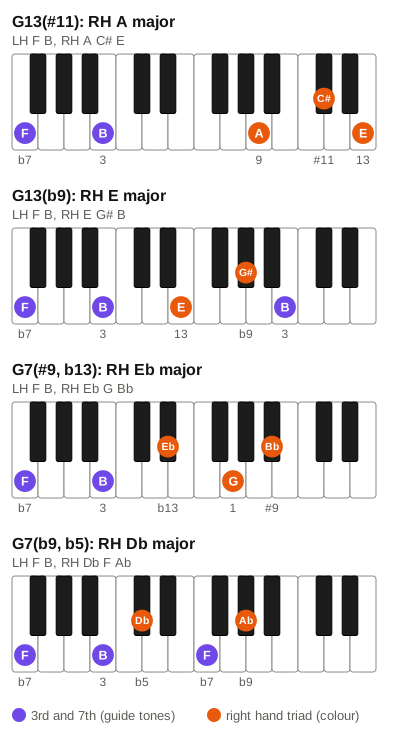
Play each one and resolve it to Cmaj7 (LH E B, RH G B D). Jazz arrangers call these upper structures, and you’ll hear them in big band brass sections as well as on piano.
Over a major chord the same idea works with one triad: over Cmaj7 (LH C E B), play a D major triad (D F# A) for Cmaj13(#11).
Over a minor chord, try a major triad built on the 7th: over Dm7 (LH D F), play C major (C E G) for Dm11.
Exercise 7
Play a ii-V-I in C: LH shells (D F C, G F B, C E B), RH triads. Dm7 with a C major triad on top, G7 with each of the four upper structures in turn, Cmaj7 with a D major triad. Four bars each version. Then pick a favourite G7 flavour and use it in the same ii-V-I in F (C7 with LH Bb E: RH D major for 13#11, A major for 13b9, Ab major for #9b13, Gb major for b9b5).
Sources
- Mark Levine (1989), The Jazz Piano Book, Sher Music, chapters on extensions, sus chords and upper structures
- Mark Levine (1995), The Jazz Theory Book, Sher Music, chapters on the altered scale and avoid notes
- Recording: Herbie Hancock, Maiden Voyage (Blue Note, 1965)