
Jazz Piano for Classical Players
Lesson 11: Your first standard, Autumn Leaves
Goal: play a complete arrangement of “Autumn Leaves”, from intro to ending, using what you’ve learnt.
Why this tune
“Autumn Leaves” (Joseph Kosma, 1945, originally the French song “Les feuilles mortes”) is one of the most played jazz standards and the classic first tune for jazz pianists. It’s almost entirely made of the two things you practised in Lesson 4: a major ii-V-I and a minor ii-V-i, in the same key, over and over.
Listen to a couple of versions before you start, so the melody is in your ear:
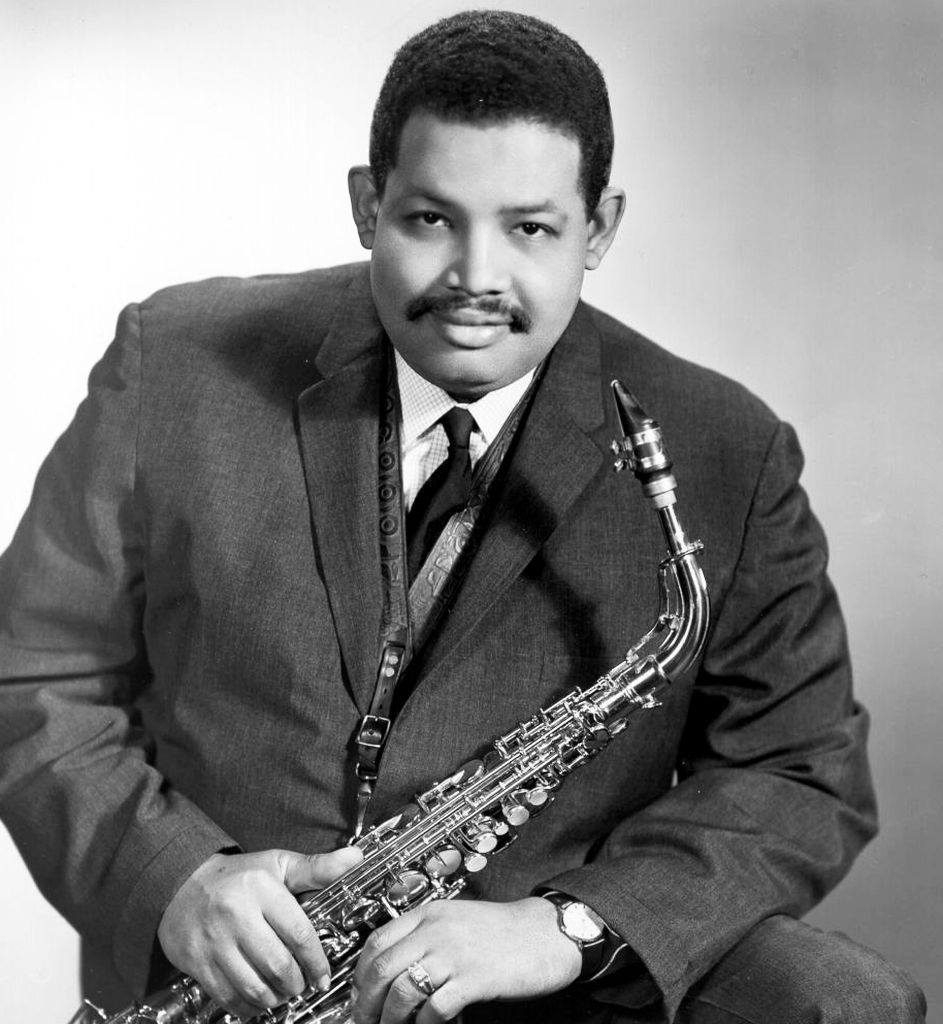
- Cannonball Adderley with Miles Davis, Somethin’ Else (1958): the long, slow, famous one
- Bill Evans Trio, Portrait in Jazz (1960): the piano trio version every pianist learns from

Getting the melody
The melody isn’t printed here, because it’s still under copyright: Joseph Kosma died in 1969, so his music is protected until the end of 2039 in Australia and Europe, and the 1945 song until the end of 2040 in the US. Buy a licensed copy instead. It’s cheap and the composer’s estate gets paid:
- The Real Book, Volume 1, sixth edition (Hal Leonard). “Autumn Leaves” is in it, along with about 400 other standards you’ll want later.
- A single lead sheet from Musicnotes, which you can transpose to any key before printing.
Chord progressions can’t be copyrighted, so the chart below is fine to share. And below that are two pieces of music written for this course over the same chords: a guide-tone study and an original melody. Writing a new tune over an existing tune’s chords is an old jazz tradition (it’s called a contrafact: Charlie Parker’s “Donna Lee” is built on the chords of “Indiana”), and it’s a great way to practise the changes.
The chords
The most common key is G minor. The form is 32 bars, one chord per bar unless shown:
| Section | Bars | Chords |
|---|---|---|
| A | 1 to 8 | Cm7 · F7 · Bbmaj7 · Ebmaj7 · Am7b5 · D7 · Gm6 · Gm6 |
| A | 9 to 16 | the same again |
| B | 17 to 24 | Am7b5 · D7 · Gm6 · Gm6 · Cm7 · F7 · Bbmaj7 · Ebmaj7 |
| C | 25 to 32 | Am7b5 · D7 · Gm7 C7 · Fm7 Bb7 · Ebmaj7 · Am7b5 D7 · Gm6 · Gm6 |
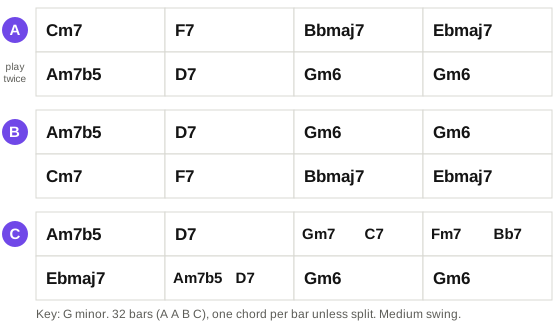
Bracket the ii-Vs the way Lesson 4 showed you:
- Cm7 F7 Bbmaj7 is a major ii-V-I in Bb.
- Am7b5 D7 Gm6 is a minor ii-V-i in G minor.
- Ebmaj7 to Am7b5 links the two. (In classical terms, it’s the falling-fifths sequence you’ll know from Baroque music.)
- Bars 27 and 28, Gm7 C7 and Fm7 Bb7, are quick ii-Vs sliding down a whole step. Many charts write Gm7 Gb7, Fm7 E7 instead: those are tritone substitutions (Lesson 10, Trick 4).
So the whole tune is really two phrases, plus a little detour near the end.
Voicings, version 1: shells
Alternating shapes so the top notes stay close:
| Chord | LH shell | Chord | LH shell |
|---|---|---|---|
| Cm7 | C Eb Bb | Am7b5 | A C G |
| F7 | F Eb A | D7 | D C F# |
| Bbmaj7 | Bb D A | Gm6 | G Bb E |
| Ebmaj7 | Eb D G |
For bars 27 and 28: Gm7 G Bb F, C7 C Bb E, Fm7 F Ab Eb, Bb7 Bb Ab D.
Voicings, version 2: rootless
These sit around middle C and lead smoothly from one to the next:
| Chord | LH rootless | Chord | LH rootless |
|---|---|---|---|
| Cm9 | Eb G Bb D | Am7b5 | C Eb G A |
| F13 | Eb G A D | D7alt | C Eb F# Bb |
| Bbmaj9 | D F A C | Gm6/9 | Bb D E A |
| Ebmaj9 | D F G Bb |
Bars 27 and 28: Gm9 Bb D F A, C13 Bb D E A, Fm9 Ab C Eb G, Bb13 Ab C D G. Each ii-V is the same shape moved down a whole step. Satisfying.
Study 1: guide tones
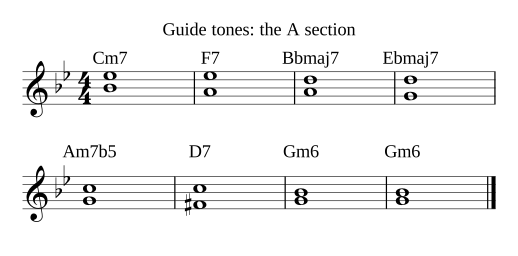
Before you play the melody, play the harmony as a melody. This is the A section with just the guide tones (the 3rds and 7ths) in the right hand, one pair per bar. Notice how the top line falls Eb, Eb, D, D, C, C, Bb by the smallest possible steps, and the lower line does the same (Bb, A, A, G, G, F#, G). That’s the 7th-falls-to-the-3rd rule from Lesson 4, running through a whole tune.
Study 2: “Late October”, an original melody
This is a 32-bar melody written for this course over the “Autumn Leaves” chords. It’s built entirely from things in earlier lessons: chord tones on the beat, an altered note (Eb over D7) resolving down, Gm6 colour (the E natural), and The Lick in C minor in bar 21. Swing the eighths. Play it with left hand shells first, then rootless voicings.
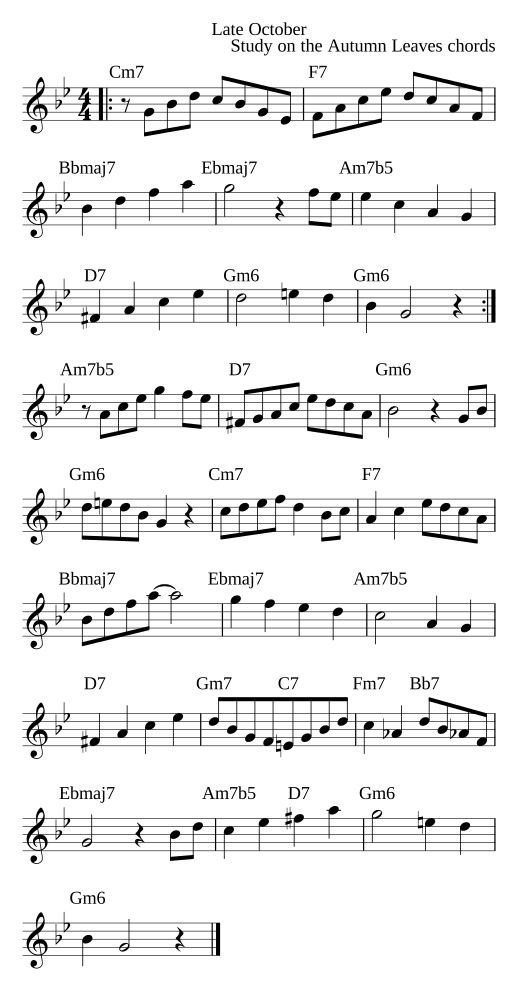
Once you can play it, use it as a model: write your own melody over the same chords, one bar at a time, using chord tones and approach notes. That’s composing and improvising at the same time, just slower.
An arrangement plan
Here’s a complete performance. Take it one stage at a time over a couple of weeks.
- Intro (4 bars). Play the last four bars (Ebmaj7 · Am7b5 D7 · Gm6 · Gm6) with rootless voicings, then a quick D7alt to set up the top.
- Head (32 bars). RH plays the melody (from your licensed copy, or “Late October” if you haven’t got one yet), swung. LH plays shells, mostly in the Charleston rhythm or on the “and” of 4 (Lesson 5).
- Solo (32 bars, or more). LH switches to rootless voicings, comping sparsely. RH improvises. For a shortcut, the G blues scale (G Bb C Db D F) sounds good over most of the tune; on the D7 chords, swap the F for F# so you don’t fight the chord. Then add chord tones, approach notes and The Lick (Lesson 9: here as G A Bb C A F G).
- Head again (32 bars). This time use block chords or octaves on the melody for the last A section (Lesson 10, Tricks 6 and 7).
- Tag ending. At bar 30 (Am7b5 D7), don’t resolve to Gm6. Go straight back to Am7b5 D7 and loop it, three times in all. Then resolve to a final Gm6/9 (LH G D, RH E A Bb). Roll it. Smile.
A word on tempo
Start slowly, around 80 beats per minute. Many classic recordings are faster, but the Adderley version is relaxed and a great model. Speed comes later. Clean, swinging and slow beats fast and stiff every time.
Exercise 11
This week, just stages 1 and 2: intro plus the head, shells in the left hand, melody in the right, with a metronome on 2 and 4 at 80. Play it through three times a session without stopping. Next week, add the solo chorus with rootless voicings. The week after, the final head and the ending.
Sources
- Wikipedia, Autumn Leaves (1945 song): composer, history and notable recordings
- Mark Levine (1995), The Jazz Theory Book, Sher Music: ii-V-I and minor ii-V-i, tritone substitution
- Recordings: Cannonball Adderley, Somethin’ Else (Blue Note, 1958); Bill Evans Trio, Portrait in Jazz (Riverside, 1960)