
Jazz Piano for Classical Players
Lesson 4: The ii-V-I, the progression behind everything
Goal: play a ii-V-I in major and minor in several keys, and spot ii-Vs in a lead sheet at a glance.
Why this one progression matters
In classical harmony you learnt that V goes to I: the perfect cadence. Jazz puts one more chord in front: the ii chord, a minor 7 a 4th below the V. So in C major you get Dm7 to G7 to Cmaj7, or “two-five-one”.
It’s everywhere. Many standards are mostly ii-V-Is in different keys, strung together. Once you can see them, a page of chord symbols stops being 32 separate chords and becomes five or six familiar phrases. That’s how jazz players memorise tunes so quickly.
The circle of fifths
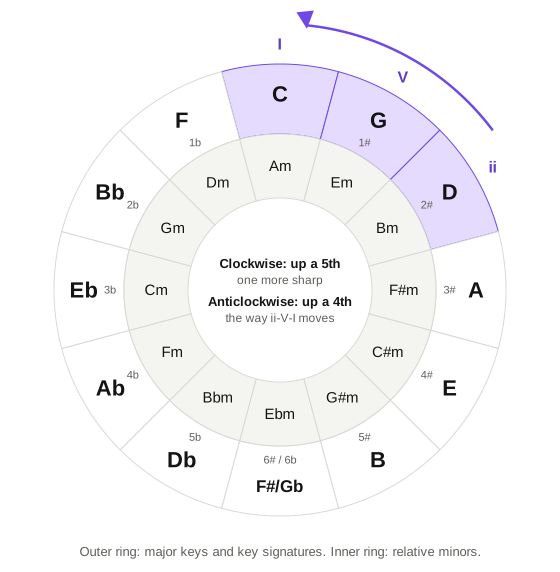
The wheel below is the map most jazz musicians carry in their heads. Going clockwise, each key is a 5th higher and has one more sharp (or one fewer flat). Going anticlockwise, each step is up a 4th, and that’s the direction a ii-V-I travels: D to G to C is three neighbouring keys, read anticlockwise.
So to find the ii-V-I in any key, find the key on the wheel, then take the two keys clockwise from it: those are your V and your ii. For F: C is V, G is ii, so it’s Gm7 to C7 to Fmaj7.
Major ii-V-I
Shell voicings from Lesson 3, alternating shapes so the top notes move smoothly. Start each one with Shape A (1-3-7):
| Key | ii | V | I |
|---|---|---|---|
| C | Dm7: D F C | G7: G F B | Cmaj7: C E B |
| F | Gm7: G Bb F | C7: C Bb E | Fmaj7: F A E |
| Bb | Cm7: C Eb Bb | F7: F Eb A | Bbmaj7: Bb D A |
| Eb | Fm7: F Ab Eb | Bb7: Bb Ab D | Ebmaj7: Eb G D |
| G | Am7: A C G | D7: D C F# | Gmaj7: G B F# |
Guide tones: the line hiding inside
Look only at the 3rds and 7ths in the C row. They make two little lines:
- C (7th of Dm7) → B (3rd of G7) → B (7th of Cmaj7)
- F (3rd of Dm7) → F (7th of G7) → E (3rd of Cmaj7)
These are called guide tones, and the rule behind them is simple: the 7th of one chord falls a half step to become the 3rd of the next. If you remember nothing else about jazz harmony, remember that. It’s why jazz solos and voicings sound “right” even when they’re full of chromatic notes: the guide tones are pulling the harmony forward.
Try this: left hand plays just the roots, low (D, G, C). Right hand plays only the guide tones: F and C, then F and B, then E and B. Sparse, but unmistakably jazz.
Minor ii-V-i
In a minor key the ii chord becomes half-diminished and the V usually gets a flat 9 for extra pull. The i chord is a minor 6 or minor 7.
In C minor: Dm7b5 to G7(b9) to Cm6.
| Key | ii | V | i |
|---|---|---|---|
| C minor | Dm7b5: D F C (+ Ab) | G7: G F B | Cm6: C Eb A |
| G minor | Am7b5: A C G (+ Eb) | D7: D C F# | Gm6: G Bb E |
| D minor | Em7b5: E G D (+ Bb) | A7: A G C# | Dm6: D F B |
The flat 9 on the V (Ab over G7, Eb over D7) comes straight from the harmonic minor scale. Add it in the right hand and you get that moody, film-noir sound.
How to spot a ii-V in a lead sheet
Look for a minor 7 chord followed by a dominant 7 a 4th higher (or a 5th lower, same thing). Gm7 to C7, Em7 to A7, Bbm7 to Eb7. That’s a ii-V. Draw a bracket over each pair in pencil.
Half-diminished to dominant (Am7b5 to D7) is a minor ii-V. Bracket those too.
Sometimes the I chord never arrives and the music jumps to a new ii-V in another key. That’s normal. Each ii-V is a short trip to a key, even if you only stay for two beats.
Exercise 4
Play the major ii-V-I in C, F and Bb, left hand shells, right hand guide tones only, two beats per chord with a metronome at 80. Then go round all twelve keys using this order (each key is a 4th up from the last): C, F, Bb, Eb, Ab, Db, Gb, B, E, A, D, G. Don’t rush this one. It might take a few weeks, and it pays back more than anything else in this course.
Sources
- Mark Levine (1995), The Jazz Theory Book, Sher Music, chapter 2 (the ii-V-I) and chapter 4 (minor ii-V-I)
- Mark Levine (1989), The Jazz Piano Book, Sher Music, chapter 2
- Wikipedia, ii-V-I progression