
Jazz Piano for Classical Players
Lesson 14: A practice plan and where to go next
Goal: leave with a daily routine, a plan for the next two months, and a list of tunes, tools and records to keep you going.
A 30-minute daily routine
Classical practice is often about perfecting a piece. Jazz practice is more like a language course: little bits of vocabulary every day, then using them. This split works well:
| Minutes | What | From |
|---|---|---|
| 5 | Voicings round the keys: one ii-V-I shape through all 12 keys | Lessons 3, 4, 6 |
| 5 | Time and swing: metronome on 2 and 4, swung scales and arpeggios | Lesson 5 |
| 10 | Your tune of the week: head, comping, a chorus of solo | Lessons 8, 11 |
| 5 | Improvise freely over a loop, no stopping | Lesson 9 |
| 5 | Listen to a record and copy one short phrase by ear | This lesson |
Short and daily beats long and weekly. Most jazz teachers say the same, and it matches how skills build: little and often. If you only have ten minutes, do the tune.
An eight-week plan
| Week | Focus |
|---|---|
| 1 | Seventh chords on five roots; shells round the circle sequence (Lessons 2, 3) |
| 2 | Major ii-V-I with shells and guide tones in six keys (Lesson 4) |
| 3 | Swing and comping rhythms; minor ii-V-i (Lessons 4, 5) |
| 4 | Rootless voicings, versions 1 and 2, in C, F and Bb (Lesson 6) |
| 5 | The F blues: voicings, blues scale, three choruses without stopping (Lesson 8) |
| 6 | Improvising tools over a ii-V-I and the blues (Lesson 9) |
| 7 | “Autumn Leaves” intro and head; two tricks from Lesson 10 |
| 8 | “Autumn Leaves” complete, with solo and tag ending; record it |
Record yourself in week 1 and week 8. Then compare.
Play-along tools
Practising alone with a metronome only gets you so far. You need to hear your voicings against a bass line.
- iReal Pro (phone, tablet or computer, one-off purchase): thousands of chord charts and a backing band that plays them in any key and tempo. You can slow it down, loop a section or practise one ii-V in all 12 keys. Probably the single most useful jazz practice tool.
- Jamey Aebersold play-alongs: real musicians recorded with the piano panned to one side, so you can turn it off and take its place. Volume 1: How to Play Jazz and Improvise and Volume 54: Maiden Voyage are good first ones.
- YouTube backing tracks: search for a tune name plus “backing track” or “play along”. Quality varies.
Where to get lead sheets (legally)
- The Real Book, Volume 1, sixth edition (Hal Leonard). The original Real Book of the 1970s was an unlicensed photocopied collection passed around music schools. Since 2004 Hal Leonard has published licensed editions, with composers paid. Get one of those.
- iReal Pro charts give chords only (no melody), so you’ll still need the melody from a book or by ear.
- Free lead sheets online are often unlicensed. Fine for a look, but buy the book if you’re going to use it.
Tunes to learn next
Picked because they reuse what you know and add one new thing each:
| Tune | Why |
|---|---|
| “Blue Bossa” (Kenny Dorham) | Minor ii-V-is plus a bossa nova groove instead of swing |
| “Cantaloupe Island” (Herbie Hancock) | Three-chord vamp; perfect for So What and quartal voicings |
| “So What” (Miles Davis) | Two chords, 32 bars, all modal: practise space and quartal chords |
| “Satin Doll” (Duke Ellington) | ii-Vs moving up and down by step |
| “Summertime” (George Gershwin) | A minor-key ballad you probably already know |
| “Fly Me to the Moon” (Bart Howard) | The circle-of-fifths sequence from Lesson 3 |
| “There Will Never Be Another You” (Harry Warren) | Classic bebop-era standard full of ii-Vs |
| “All the Things You Are” (Jerome Kern) | The big one: ii-V-Is through five keys |
Learn from records
Jazz has always been learnt by ear, from recordings. Musicians call it transcribing: copying a solo or a voicing from a record. You don’t have to write it down. Start tiny:
- Pick one short phrase, a few seconds long, from a pianist you love.
- Slow it down with YouTube’s playback speed setting, or an app built for it such as Transcribe! or Amazing Slow Downer.
- Sing it, then find it on the piano. Then learn it in two more keys.
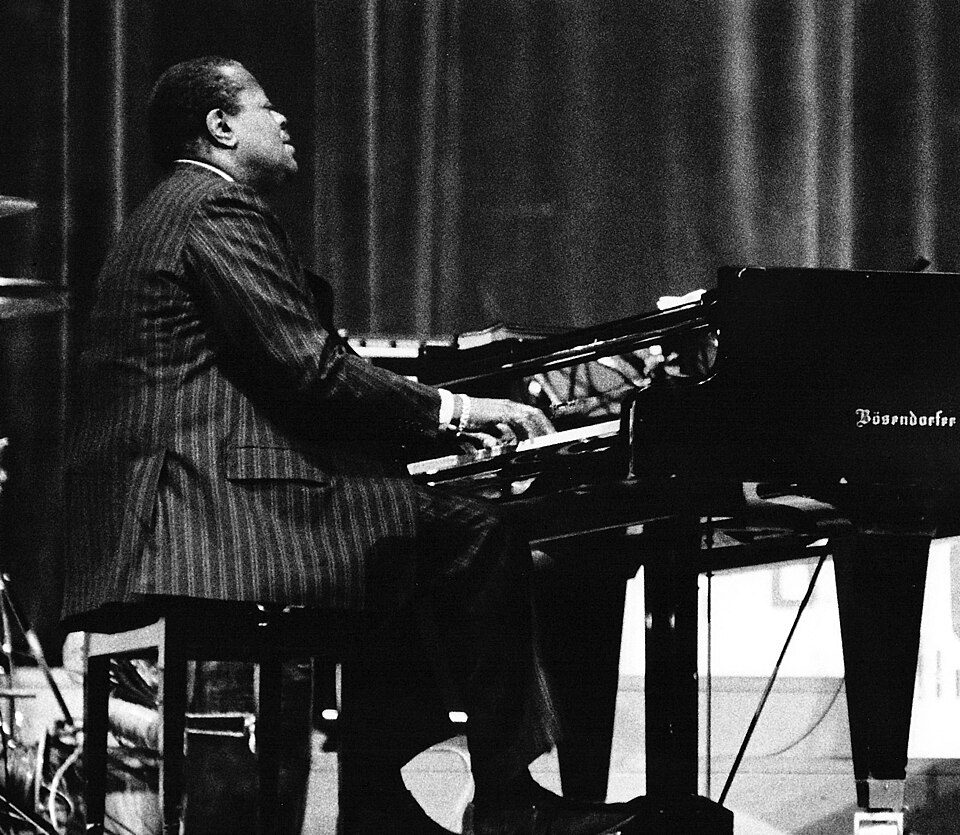
Pianists to listen to, roughly in order of how easy they are to learn from: Red Garland, Wynton Kelly, Oscar Peterson, Bill Evans, Herbie Hancock, Thelonious Monk, McCoy Tyner, Bud Powell.

Books and teachers
- Mark Levine, The Jazz Piano Book (Sher Music, 1989). The standard text. Much of this course follows its order. Dense, but it’ll last you years.
- Mark Levine, The Jazz Theory Book (Sher Music, 1995). The theory behind it.
- Online: Open Studio, Piano With Jonny, Jazz Tutorial and Learn Jazz Standards all have free lessons alongside paid courses.
- A real teacher. Even a handful of lessons with a jazz pianist will fix habits you can’t hear yourself. Look for one who’s happy to work with adult classical players; many love it, because you can already read and play.
Exercise 14
Make a recording today: whatever you can play right now, even just the ii-V-I from Lesson 4. Save it with today’s date. Then set your eight-week plan in your calendar, starting tomorrow. And go and play with people when you can: jam sessions, community big bands and adult jazz workshops are friendlier than you’d expect, and playing with a bass player is when all of this really clicks.
Sources
- Wikipedia, The Real Book: history and Hal Leonard licensed editions from 2004
- iReal Pro and Jamey Aebersold Jazz: product details
- Mark Levine (1989), The Jazz Piano Book, Sher Music