
Jazz Piano for Classical Players
Lesson 9: Improvising without a score
Goal: improvise a few choruses over a ii-V-I or a blues using a small set of tools, without freezing up.
Why it feels so hard
If you were trained to play exactly what’s written, improvising can feel like being asked to give a speech in a language you’ve only ever read. That’s a fair comparison, and it points to the fix: nobody learns to speak by inventing sentences from nothing. You start with phrases you’ve heard, change a word here and there, and build up.
Jazz musicians call those phrases vocabulary or licks, and they learn them by copying records. Improvising is mostly recombining things you know, with a few new things on top. So we start with tight limits and loosen them gradually.

Step 1: Vary the melody
The easiest improvisation is the tune itself, changed a bit. Take the melody of any standard and:
- Shift the rhythm. Start a phrase half a beat early or late.
- Add a note before an important melody note (a half step below works almost every time).
- Leave a note out, or hold one longer.
Lester Young, the great saxophonist, said you should know the lyrics of a tune before you solo on it. The melody is always your safest starting point.
Step 2: Target chord tones
The notes that make a line sound connected to the chords are the chord tones: 1, 3, 5 and 7. The rule of thumb in bebop, the style most jazz education is built on:
Chord tones on the beat, anything goes in between.
Try it with quarter notes over Dm7 to G7 to Cmaj7, playing only chord tones and moving to the nearest one each time the chord changes. Then add an eighth-note passing note between each pair. You’ve just played a bebop line.
Step 3: Approach notes and enclosures
Any target note can be approached from a half step below. It sounds like you meant it, every time. To land on E (the 3rd of Cmaj7) on beat 1, play D# just before it.
An enclosure surrounds the target: one note above, one below, then the target.
To land on E: play F, then D#, then E
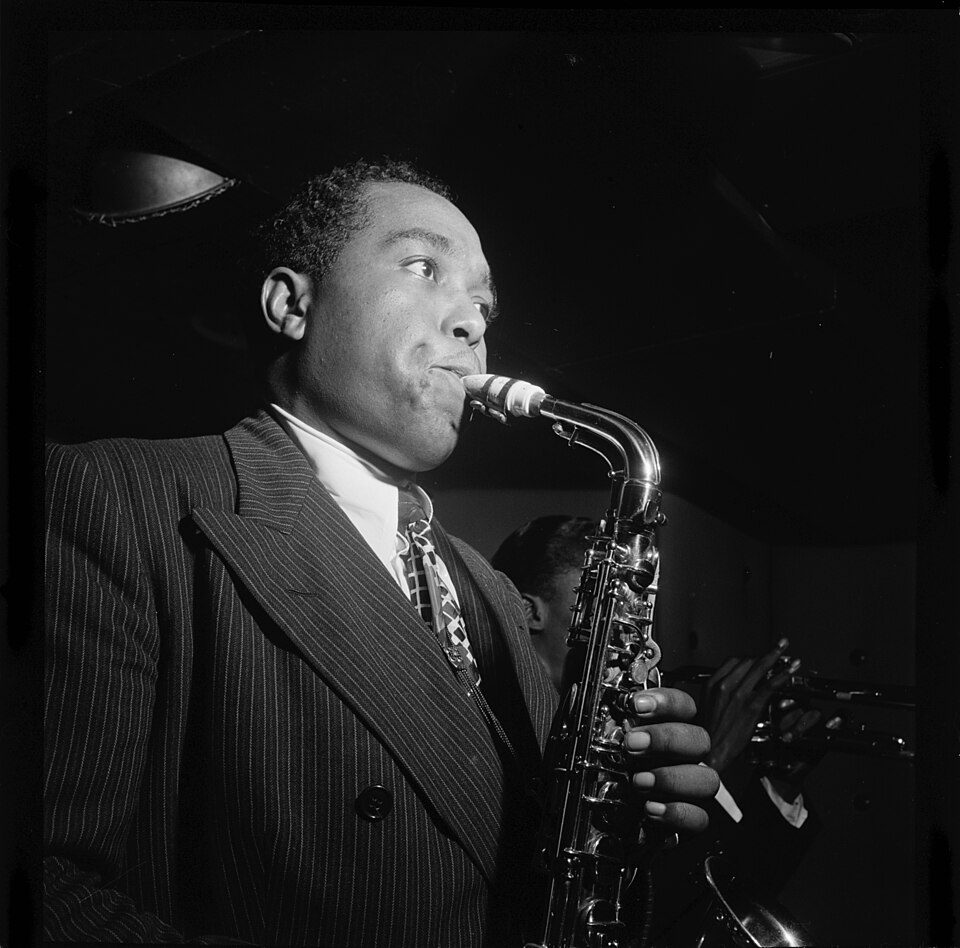
Enclosures are all over Charlie Parker’s playing, and they’re a fast way to sound like you’ve been listening to bebop.
Step 4: The bebop scale
Here’s a neat trick for descending lines over a dominant chord. The bebop dominant scale is a Mixolydian scale (the major scale with a flat 7) with one extra passing note, the major 7th:
On G7: G F# F E D C B A G
Because it has eight notes, if you start on a chord tone on the beat and run down it in eighth notes, every chord tone (G, F, D, B) lands on a beat. That’s why it sounds so “right”. Try it starting from G on beat 1 over a bar of G7, then resolve to E or C on the Cmaj7.
Step 5: Pentatonics
A pentatonic scale (five notes, no half steps) sounds good almost anywhere. Some reliable choices:
| Chord | Pentatonic | Notes |
|---|---|---|
| Dm7 | F major pentatonic | F G A C D |
| G7 | G major pentatonic, or Bb minor pentatonic for an altered sound | G A B D E / Bb Db Eb F Ab |
| Cmaj7 | G major pentatonic (modern, bright) | G A B D E |
McCoy Tyner and Herbie Hancock used pentatonics like this in the 1960s, moving them around to get a modern, open sound.
Step 6: Steal a lick
Learn a phrase from a record and use it on purpose. To get you started, here is the most famous lick in jazz, so common it’s become a joke among musicians. It’s simply called The Lick. Over Dm7 (or any D minor moment):
D E F G E C D
Swing it: D E F G as eighth notes, then E, a little gap, C, D. Once you know it you’ll hear it everywhere. Then play it over Gm7 (G A Bb C A F G) and Cm7.
Six ways to stop freezing
- Limit yourself. Three notes only. Or one bar playing, one bar resting. Limits make it easier to start.
- Space is good. Miles Davis left huge gaps. Rests are part of a solo, not a failure.
- Call and response. Play a two-bar idea, then answer it with a two-bar variation.
- Sing it. If you can sing a phrase, you can play it. Try singing a line over the chords, then finding it on the keys.
- Never stop for a mistake. Keep the form going. If a note clashes, move it a half step and call it an approach note.
- Record and listen back. It’s usually better than it felt.
Exercise 9
Set up a ii-V-I in C, two bars each chord, on iReal Pro or a loop, or play the left hand shells yourself. Improvise for five minutes in four stages: (1) chord tones only, quarter notes; (2) add approach notes from a half step below; (3) add one enclosure per phrase; (4) end every phrase with The Lick, moved to fit. Keep going through the clashes.
Sources
- Mark Levine (1995), The Jazz Theory Book, Sher Music, chapters on bebop scales and pentatonics
- David Baker (1985), How to Play Bebop, Alfred: the bebop scale
- Jazzmentl (YouTube), Jazz Piano for Classical Pianists
- Lester Young on knowing the lyrics: widely quoted, recalled by Dexter Gordon among others; treat as jazz lore rather than a documented quote