
Jazz Piano for Classical Players
Lesson 8: The blues
Goal: play a 12-bar jazz blues in F with your own voicings, and improvise over it using the blues scale.
Why start improvising here
The blues is the jam session tune everyone knows. It’s short (12 bars), repeats endlessly, and the blues scale sounds good over all of it. If you can play a blues in F, you can sit in almost anywhere. Jazz players have been writing tunes on this form for a century: “Billie’s Bounce”, “Now’s the Time”, “Straight, No Chaser”, “Blue Monk” and “Freddie Freeloader” are all 12-bar blues.

The form
The basic blues has three chords, all dominant 7s, which is already unusual if you’re used to classical harmony:
| Bars 1 to 4 | F7 | Bb7 | F7 | F7 |
|---|---|---|---|---|
| Bars 5 to 8 | Bb7 | Bb7 | F7 | F7 |
| Bars 9 to 12 | C7 | Bb7 | F7 | C7 |
Jazz players dress it up with ii-Vs. This is the standard jazz blues in F:
| Bars 1 to 4 | F7 | Bb7 | F7 | Cm7 F7 |
|---|---|---|---|---|
| Bars 5 to 8 | Bb7 | Bdim7 | F7 | D7 |
| Bars 9 to 12 | Gm7 | C7 | F7 D7 | Gm7 C7 |
Bar 4 is a ii-V into Bb. Bars 8 to 10 are D7 (a V of Gm7) into a ii-V back home. Bars 11 and 12 are a turnaround: a quick loop that sends you back to the top.
Voicings
Shells (Lesson 3). Notice how F7 and Bb7 swap just two notes, each by a half step:
| Chord | Shell | Chord | Shell |
|---|---|---|---|
| F7 | F A Eb | Bdim7 | B D Ab |
| Bb7 | Bb Ab D | D7 | D C F# |
| Cm7 | C Eb Bb | Gm7 | G Bb F |
| C7 | C Bb E |
Rootless (Lesson 6). Bars 1 and 2 are the famous pair:
- F9: A C Eb G (A form)
- Bb13: Ab C D G (B form)
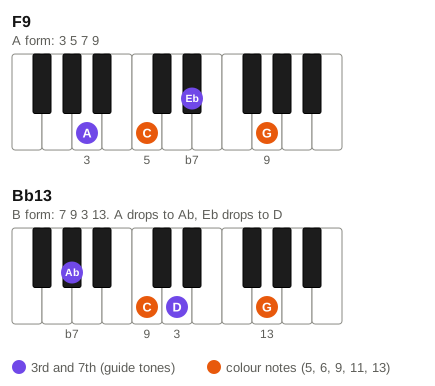
Only two notes move, each by a half step: A goes down to Ab, Eb goes down to D. Rock between those two chords in a swung Charleston rhythm and you’re playing the blues.
The blues scale
The F blues scale has six notes:
F Ab Bb B C Eb F
That’s a minor pentatonic scale (F Ab Bb C Eb) plus one extra note, the B natural (the flat 5, or “blue note”). Play it up and down a few times. Then play it over the whole 12 bars, every chord. It works everywhere, which is why the blues is the friendliest place to start improvising.
The trick is that the Ab clashes with the A in the F7 chord, and that clash is the blues. Lean on it, then slide off it.
Three blues moves
- The crush. Play Ab and A together (or Ab as a fast grace note into A) over F7. That “wrong note” crunch is pure blues piano. You can do it in any key: the minor 3rd crushed into the major 3rd.
- Repeat yourself. Pick a three-note idea, such as C Eb F, and play it four times over the first four bars. Repetition sounds intentional. Blues players do it all the time.
- The bend you can’t do. Pianos can’t bend notes like a guitar, so pianists fake it: trill quickly between Ab and A, or between B and C, and resolve.
A simple blues head to learn
Here’s a riff in the style of a 1950s blues head. Play it in the right hand over bars 1 to 4, then again over bars 5 to 8, then a final time over bars 9 to 12. Swing the eighths:
F Ab A C (crush the Ab into the A) . . . Eb C (rest)
Copying riffs over the same form three times is exactly how many real blues heads are built. Make up your own versions.
Exercise 8
Put on Miles Davis, “Freddie Freeloader” (a blues in Bb, not F, but listen to the form go round). Count the 12 bars and try to hear where each new chorus starts. Then at the piano: left hand plays the jazz blues in F with shells, one chord per bar in a Charleston rhythm, metronome at 60 on 2 and 4. Right hand plays the blues scale, two notes at a time at first, leaving lots of space. Do three choruses without stopping, even if you play something you don’t like. Not stopping is the skill.
Sources
- Mark Levine (1995), The Jazz Theory Book, Sher Music, chapter on the blues
- Wikipedia, Twelve-bar blues
- Recordings: Thelonious Monk, “Blue Monk” (1954); Miles Davis, “Freddie Freeloader” (1959); Oscar Peterson Trio, “C Jam Blues” on Night Train (1963)