
Jazz Piano for Classical Players
Lesson 5: Swing feel and comping rhythms
Goal: play swung eighth notes that sound relaxed rather than stiff, and accompany yourself with a few classic jazz rhythms.
The biggest giveaway
You can play all the right chords and still sound like a classical pianist reading jazz. The giveaway is rhythm. Classical training drills even, square eighth notes, a strong beat 1 and a careful legato. Jazz wants almost the opposite. This lesson is probably the one that will change your sound the most.
Swung eighths: long, short
In swing, a pair of eighth notes isn’t split 50/50. The first is longer, the second shorter, roughly like the first and last notes of a triplet. Say it out loud:
doo-ba doo-ba doo-ba doo-ba
or, as many teachers do, “doo-BAH”. Two details matter as much as the long-short:
- Accent the off-beat. The short note (the “ba”, or the “and” of the beat) gets a little push. Classical players do the reverse and lean on the beat.
- It’s not a strict triplet. At slow tempos the swing is wide, close to a triplet. At fast tempos it gets closer to even. Listen to the records and copy, don’t calculate.
Lead sheets nearly always write swung eighths as ordinary eighth notes. It’s assumed, the same way you’d assume a Chopin waltz has rubato.
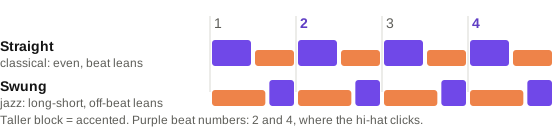
The beat lives on 2 and 4
In classical music beat 1 is the strong beat. In jazz, the drummer’s hi-hat clicks on beats 2 and 4, and that’s where the groove sits. Audiences who clap on 1 and 3 are, famously, the wrong audience.
Set your metronome to half speed and treat each click as beat 2 or beat 4. So at a tempo of 120, set it to 60 and count “1 2 3 4” with the clicks on the bold numbers. It feels odd for a day or two, then it feels like swing.
Ghost notes and articulation
A few habits that shift your right hand from “classical” to “jazz”:
- Not every note is equal. In a run of swung eighths, some notes almost disappear. These are ghost notes: barely touched, more felt than heard. Typically the on-beat notes in a line are lighter and the off-beats are stronger.
- Legato into the off-beat, short at the end. A common pattern is to slur from the on-beat into the off-beat, then detach. The last note of a phrase is often short and accented: “doo-ba-doo-ba-DAT”.
- Lay back. Good swing sits slightly behind the beat, relaxed, never rushing.
Comping: how to play chords in rhythm
Comping (from “accompanying” or “complementing”) is what a jazz pianist’s chords do behind a melody or soloist. It’s never “a chord on every beat”. Instead you play short, rhythmic stabs and leave space. Three to start with, each over one bar of 4/4:
| Name | When you play the chord | Count |
|---|---|---|
| Charleston | Beat 1, then the “and” of 2 | 1 2 & 3 4 |
| Reverse Charleston | The “and” of 1, then beat 3 | 1 & 2 3 4 |
| Anticipation | The “and” of 4, tied over into the next bar | 1 2 3 4 & |
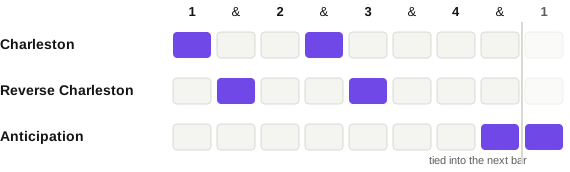
The anticipation is the most jazz-sounding of the three: you play the next bar’s chord half a beat early. Pianist Red Garland made it a trademark, playing chords on the “and” of 2 and the “and” of 4 behind Miles Davis in the 1950s.
Keep the chords short (staccato, no pedal) for medium and fast tempos. Hold them longer on ballads.

Exercise 5
Put on Miles Davis, “Freddie Freeloader” from Kind of Blue (the pianist is Wynton Kelly) and clap along on 2 and 4 for a whole chorus. Then go to the piano. Set the metronome to 60 on 2 and 4 (tempo 120) and play the ii-V-I in C from Lesson 4 with shells, using the Charleston rhythm for two bars, then the anticipation for two bars. Finally, play a C major scale up and down in swung eighths with the right hand, accenting the off-beats. Record yourself on your phone and listen back: does it swing or does it march?
Sources
- Mark Levine (1989), The Jazz Piano Book, Sher Music, chapters on comping and rhythm
- Wikipedia, Swing (jazz performance style): swing ratio varies with tempo
- Recordings: Miles Davis, Kind of Blue (1959); Miles Davis Quintet, Relaxin’ (1958) with Red Garland